

Daniela Daz Moretti and the Language of Italian Handmade Ceramics
Updated: Feb 3
Italian handmade ceramics are more than objects; they are vessels of memory, culture, and presence. Among today’s interpreters of this tradition stands Daniela Moretti (Recale, 1978) — an artist who weaves together sculpture and ceramics into a language deeply evocative.

From Words to Clay
Moretti’s artistic path began not in clay but in poetry and writing. She recalls:
“My journey began with writing and poetry, which were the first tools for shaping emotions and memory. Over time I felt the need to move this research into a material, three-dimensional language, and I found fertile ground in ceramics and sculpture.”
For her, design has never been a pragmatic starting point but “a natural consequence: the desire to create forms that are essential, minimal, and evocative, uniting functionality and poetry.”Cecilia
A Philosophy of the Nido
At the heart of Moretti’s work lies the archetype of the Nido (nest):
“The nest is an archetypal form that contains both belonging and abandonment, protection and openness. It is a threshold between the visible and invisible, an anticipation of emptiness and memory.”
Her works are not ornamental but thresholds — invitations to pause, to look inward, to inhabit fragility.

Tradition and Contemporary Vision in Italian Handmade Ceramics
Raised within Italy’s rich craft culture, Moretti draws inspiration from her Campanian roots and the ceramic traditions of Faenza and Friuli, which form part of the wider material and technical landscape of Italian handmade ceramics.
“Growing up in Italy means breathing in craftsmanship and memory—from folk objects to classical sculpture. The Campanian roots of my childhood shaped my sensitivity. Today it is above all the ceramic traditions of Faenza and Friuli that nourish my work, which I seek to renew with a contemporary and poetic vision.”
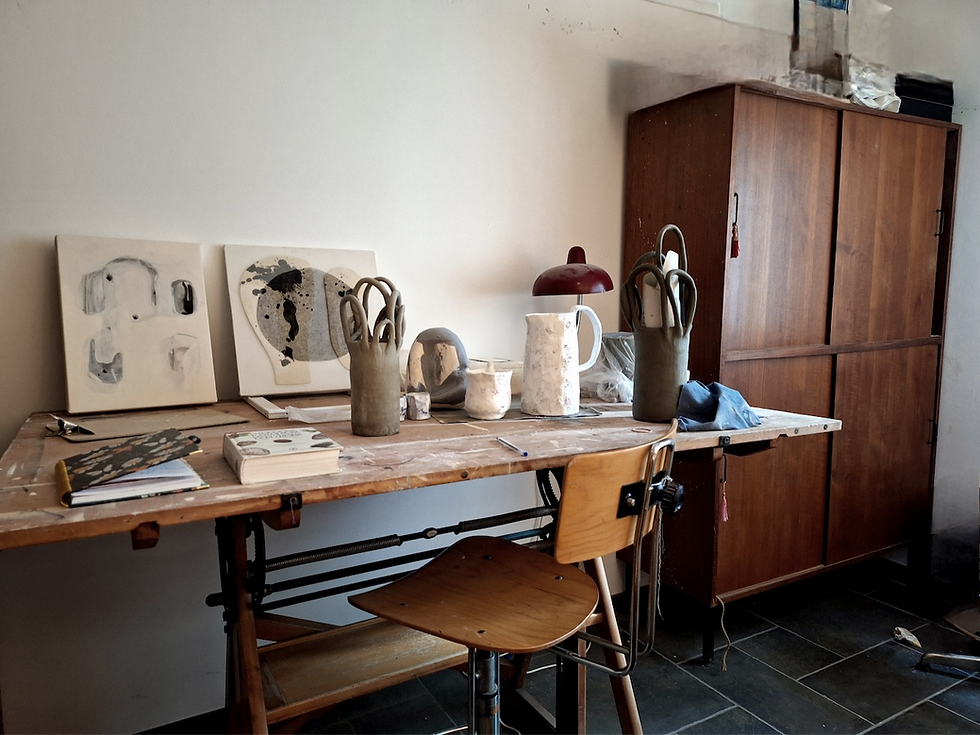
Her works are produced in small batches or unique editions, each one reflecting the singularity of the gesture, the clay, the fire, and the moment of its creation.
The Dialogue with Materials
Moretti describes her process as a dialogue with matter:
“Sometimes the clay itself suggests the technique: Kurinuki when I want to carve and let the form emerge; Mishima or incision when I want the mark to become memory. Colour is just as intuitive: I alternate cool and warm tones to give body to different states of mind.”
She often employs techniques such as Kurinuki and Mishima. Kurinuki is a Japanese method of carving directly from a solid block of clay, producing spontaneous, irregular forms that preserve the trace of the gesture. Mishima is an ancient inlay technique, incising lines into the surface and filling them with contrasting pigments or slips. Some works combine both, enriched with glazes and oxides to create layered depth and subtle contrasts.
She alternates between Apache clay — a natural red terracotta rich in mica particles that shimmer after firing, exalting its archaic, primordial quality — and earthenware, a broader category of low-fired clays suited to glazing. This careful material choice allows her to balance roughness with refinement.
Her firing process typically involves two or three stages: a first bisque at 980–1000°C, followed by one or two glaze firings between 1020–1060°C. This layering of firings gives her surfaces transparency and stratification — qualities she describes as emotional landscapes.
Body Cartographies and Emotional Landscapes
Moretti often refers to her works as “body cartographies” and “emotional landscapes.” The surfaces recall anatomical traces — skin, scars, organs — as if they were maps of the body. Cavities and openings become intimate landscapes, spaces for memory and emotional states.
These explorations link back to the recurring archetype of the Nest: a universal symbol of protection and openness, intimacy and exposure, fullness and emptiness. In Moretti’s work, the nest is never a closed form but a space open to experience, a vestibule between visible and invisible. At once refuge and vertigo, it embodies both material concreteness and existential metaphor. This attention to interiority and gesture resonates with other contemporary Italian ceramic practices shaped by intuition and material sensitivity, such as Anna Resmini’s work.

To gain deeper insight into her practice and the ideas that shape her Italian handmade ceramics, we spoke with Daniela Moretti about her philosophy, materials, and the stories behind her most significant works.
Interview with Daniela Moretti
What does creating in small batches or limited editions mean to you?
It means preserving uniqueness. Every work comes from a process that can’t be replicated identically, because it depends on the gesture, the material, the fire, and the moment in which it’s made. Working in limited editions means valuing time and unrepeatability, resisting homogenization, and giving collectors the sense of holding something unrepeatable and intimate.
How would you like your work to be perceived in someone’s home?
As a silent presence, able to accompany everyday life without imposing itself. My works are like inner nests: places of comfort, reflection, and intimacy — mirrors of emotions belonging to those who observe them.
Have you ever collaborated with other artisans or designers?
Yes — with artists and highly experienced ceramicists. Each collaboration taught me that exchange opens new perspectives, pushing me to embrace other rhythms and techniques. Above all, I learned that manual knowledge is best transmitted through direct, almost bodily sharing.
How has your aesthetic research changed over time?
At first I sought more descriptive, narrative forms. Over time I felt the need to strip them back, to lighten them, until I reached a more essential and intimate language — more tied to light, voids, and threshold spaces. Recently I’ve integrated new materials and palettes, without losing the central core: the idea of the Nest as archetype and universal metaphor.
Exhibitions and Awards
In recent years, Daniela Moretti has participated in group exhibitions and artist residencies across Italy. Notably, she was a finalist in the Arteam Cup (2023) and the Premio Luigi Candiani (2024), affirming her role as one of the emerging voices in contemporary Italian ceramics.
Questions Collectors Ask
Collectors often ask about the techniques, materials, and meanings behind Italian handmade ceramics — here are some of the most frequent questions.
What is Kurinuki?
Kurinuki, a carving technique that allows the form to emerge through subtraction, and Mishima, an inlay process where marks become memory, are central to her practice. These techniques belong to a broader vocabulary of ceramic making explored in our essential guide to Italian handmade ceramics.
What is Mishima?
Mishima is an ancient inlay technique. Lines are incised into the clay surface and then filled with contrasting slips or pigments before firing.
What’s the difference between Apache clay and earthenware?
Apache clay is a natural red terracotta that contains mica, which shimmers after firing. Earthenware is a broader category of low-fire clays, denser and often finished with glaze.
What do “body cartographies” and “emotional landscapes” mean?
They are terms Daniela Moretti uses to describe surfaces that recall anatomical traces (like skin or scars) and inner landscapes—forms and voids that act as spaces for memory and emotion.
These questions remind us that Italian handmade ceramics are not only beautiful objects but also vessels of knowledge, memory, and tradition — a living heritage that continues to evolve.
Explore the collection Signature Collection
Selected works by Daniela Daz Moretti, developed as part of her signature collection for Avant Craft. The collection translates her research into form, material, and archetype into a small, coherent body of ceramic works. Explore the collection


