

The Soul of Handcrafted Porcelain: Alice Reina's Journey
Updated: Feb 3
In a design world often dominated by aesthetic trends, a new generation of emerging Italian designers is returning to the essentials: material integrity, personal expression, and a deep connection to process. Alice Reina, a Turin-based Italian porcelain artist, is one of the most compelling voices in this quiet revolution in the world of Italian handmade ceramics.
Her work is a clear example of handcrafted porcelain design with a soul—each piece shaped by hand, inspired by literature and botany, and infused with a quiet poetic presence. Reina works with porcelain, one of the most refined and expressive ceramic materials within the wider field of Italian handmade ceramics, to craft both functional objects and sculptural pieces that speak to those who value thoughtful, intentional living.
In this interview, Reina shares her thoughts on inspiration, slow making, and the power of creating soulful objects that define a new language of Italian home decor.

Alice Reina in her studio 
A layer of porcelain modelled by two hands
"True craftsmanship begins by listening to the material—handcrafted porcelain design takes shape slowly, with intention, care, and deep respect for every gesture."
How did your journey into design and craftsmanship begin?
I studied architecture at the Polytechnic University of Turin. After graduation, I worked in the field for several years between Turin and Milan. During this time, I often dealt with custom furniture design. Collaborating directly with master artisans deepened my appreciation for craftsmanship.
I have always been drawn to the process of turning drawings into tangible objects. Eventually, it was inevitable that I would shift from being just a designer to someone who brings ideas to life with her own hands.
What materials do you love working with the most, and why?
I enjoy exploring different materials, such as paper, metals, and wax. They are ideal for small sculptures and jewelry. Yet, porcelain remains my favorite.
I can’t pinpoint exactly how my journey with porcelain began. It was a mix of chance and a path shaped by lateral thinking — decisions that led me to a work that feels genuinely mine, even though I never planned for it.
Is there a philosophy guiding your creative process?
Looking back, I see certain traits that are central to my methodology. I tend to think in modules—simple elements multiplied, combined, assembled, or divided to create complex pieces or collections.
Literature is an endless source of inspiration. Words, phrases, or sentences often cling to me. I let them simmer in my mind, unforced, until a project emerges—when I’m lucky. These words are like seeds that blossom into objects.

Is there a piece you feel particularly connected to, and what is its story?
Many pieces hold special meaning for me, but one stands out: Lungs. This project began with a poem by Nina Cassian that resonated deeply with me. The series explores childhood memories—moments of running breathlessly through familiar places.
These experiences are translated into evocative porcelain textures that evoke memory, movement, and personal landscapes.
What does creating in small batches or limited editions mean to you?
By nature, my work is slow. Everything is handcrafted at my table. Each piece is unique, even within the same collection. While they share dimensions or color palettes, the variations give each creation a distinct character.
I find this personal touch essential. Uniqueness adds depth to the experience of each piece, fostering a connection with different people.
How would you like your work to be perceived by those who welcome it into their home?
In my personal life, I value empty space—areas where a few objects can evoke strong emotions. They might be functional or not, but I love that they transport me to other contexts.
In my creations, I aim to suggest a double soul. Each object possesses its function and what we project onto it. My hope is that those who choose my work can perceive—or better yet—overlay their own memories and interpretations onto it.

Handcrafted white porcelain vase 
Detail of the rim of a handcrafted white porcelain vase 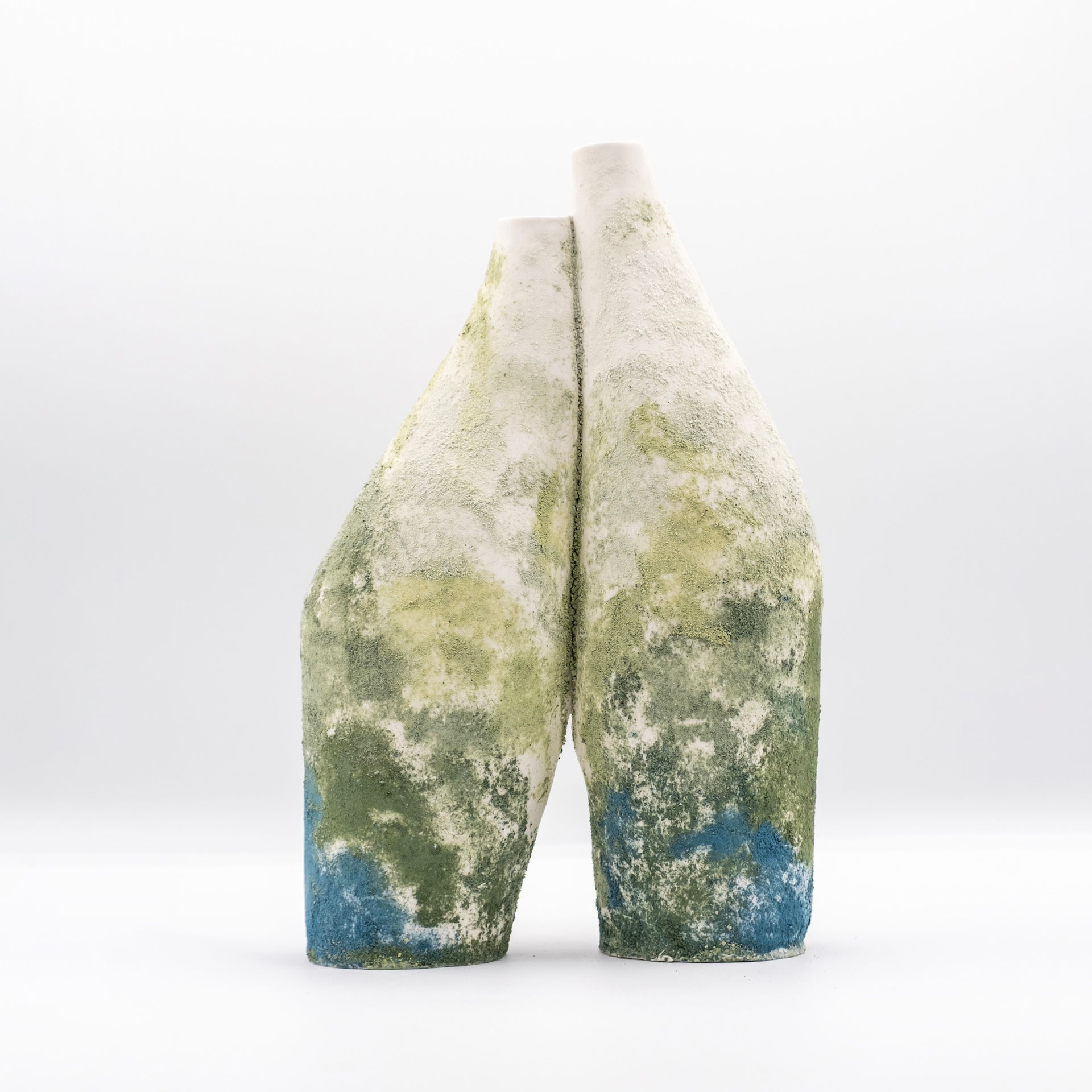
Handcrafted coloured porcelain vases 
Detail of th handcrafted coloured porcelain vase
What role does tradition—local or family—play in your creative process?
I don’t have a direct connection to local or family tradition in a strict sense. Porcelain is not part of Italian, let alone Piedmontese, heritage. My techniques differ entirely from traditional Italian approaches.
What I draw from tradition is more of a subconscious memory of places where I felt at home. Those memories become timeless design objects that resonate with a universal sense of place.
What are you trying to communicate through your work?
Every object can exhibit a double soul: its purpose and what we project onto it. A carafe can transform into a pair of herons. A vase might represent a domestic garden, and a cup can become a quiet companion.
Have you ever collaborated with other artisans or designers? What did you learn?
I’ve collaborated multiple times with other designers and artists, especially illustrators. Each project offers opportunities for shared creativity.
Combining different materials is always a challenge, but stepping into another artist’s world is inspiring. Interestingly, I often find my references outside ceramics—like paper and Japanese design, both traditional and contemporary.
How has your aesthetic research evolved over time?
Being self-taught meant I relied on instinct in my early years, learning through inevitable failures. Over time, I’ve honed my skills with this complex material. I’ve also learned what I genuinely want to express—and just as importantly, what I don’t.
Through exploration and experimentation, I continue to refine my approach to handcrafted porcelain design, always aiming for a soulful connection with those who engage with my work. This sculptural and material-driven approach places her within a broader contemporary exploration of porcelain in Italian practice, alongside artists such as Etra Masi.
Explore the collection
Selected works by Alice Reina, developed as part of her signature collection for Avant Craft. The collection translates her research into porcelain, memory, and modular form into a quiet, coherent body of objects. Explore the collection


