Collect Art Fair 2026 London. A Visual Narrative on Contemporary Craft
Updated: Sep 4
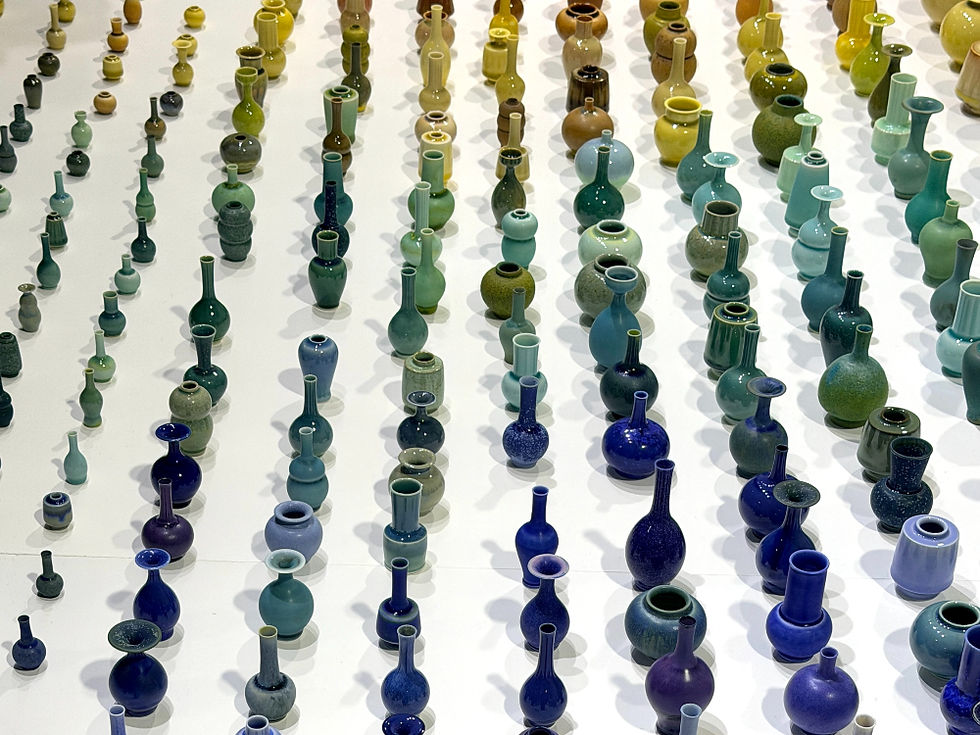
This year, we engaged with Collect Art Fair 2026 at Somerset House in London. This fair is the Crafts Council’s leading international contemporary craft event, dedicated to museum-quality craft and collectible design.
Recognised as one of the most significant international contemporary craft fairs in London, Collect convenes specialist craft galleries, established masters, and emerging practitioners. They work across various disciplines, including ceramics, lacquer, metal, wood, glass, and textiles. Since its inception in 2004, the fair has remained at the forefront of contemporary craft practice. It creates a platform where material intelligence and conceptual clarity operate in direct dialogue. This international exchange resonates with our ongoing research into contemporary ceramic practice, particularly within Italian design.
Under the direction of Fair Director TF Chan, the 2026 edition further strengthened the evolving relationship between contemporary craft and collectible design. It maintained the curatorial rigor that continues to define Collect within the international design calendar.

What follows is not an exhaustive overview of the fair. Instead, it is a visual narrative — a considered reflection on a selection of works that formed part of our broader engagement with this year’s edition.
At BR Gallery, Aya Iwata’s vessels blur the lines between jewellery, sculpture, and devotional objects. Formed in silver-based cloisonné enamel, their surfaces unfold in abstract compositions polished to luminous depth. Cloud-like lids in pâte de verre introduce softness, creating a glass appearance that seems suspended. Circular lines and cloud motifs evoke a spiritual architecture, poised between presence and absence.
With Mono Art, Yoshito Yamashita — a designated Living National Treasure — exemplifies the refinement of Japanese lacquer. Through mastery of the kinma and makie techniques, he incises and fills fine lines with colour and precious metal powders. This produces abstract compositions that distil natural movement into surfaces of exceptional control and luminosity. Motion is contained within stillness; tradition is articulated through contemporary abstraction.
Left: Aya Iwata, Kumonoie. Silver-based enamel and pâte de verre. BR Gallery. Right: Yoshito Yamashita, Cumulus Cloud, Summer, 2017. Lacquer. Mono Art. Ph. Amalia Di Lanno
In dialogue with this lineage, Yuki Nakamura, presented by WAJOY, approaches lacquer through reconstruction. Fragments gathered from the shoreline — shells shaped and eroded by waves — are reconnected using urushi lacquer. Incorporating Japanese paper, eggshell, mother-of-pearl, gold leaf, and brass powder, the work allows fractures to remain visible while being structurally resolved. Repair becomes transformation, reflecting the continual negotiation between dissolution and emergence found in nature.
Extending this exploration of organic form and material resilience into ceramics, Claire Lindner, presented by Daguet-Bresson, articulates sculpture through vertical movement and controlled expansion. Her elongated, branching forms in deep red and earthen tones suggest growth while maintaining structural clarity. Surface and silhouette operate in equilibrium, allowing gesture and discipline to coexist.
Left: Yuki Nakamura, A piece of life_09, 2022. Urushi lacquer, Japanese paper, eggshell, mother-of-pearl, gold leaf, brass powder. WAJOY. Right: Claire Lindner, 2025. Ceramic. Daguet-Bresson. Ph. Amalia Di Lanno
From this emphasis on structure and surface, the dialogue continued through ceramic materiality at County Hall Pottery. Here, Alex Simpson’s Face Mask explores glaze as both surface and concept. Developed during her residency in Jingdezhen, the work shifts attention from form to finish. It uses layered glaze to emphasise the ceramic surface as a site of inquiry rather than mere ornament.
At Caroline Fisher Projects, Emily Stapleton Jefferis presented works inspired by lichen, each titled after a specific species. Her ceramic forms move between the microscopic and the monumental, reflecting an interest in symbiotic growth and gradual transformation. Alongside her, Helena Lacy’s ongoing Re-print series examines how ceramic surfaces preserve and distort narrative. Using a glaze-printing method developed during her MA at the Royal College of Art, she reinterprets classical blue-and-white porcelain imagery through repetition and layered distortion. This allows motifs to fragment and overlap.
Left: Alex Simpson, Face Mask, 2024. Glazed ceramic. County Hall Pottery. Right: Emily Stapleton Jefferis, Carbonia, Lichen wall piece 3, 2025. Glazed stoneware. Caroline Fisher Projects. Ph. Amalia Di Lanno
Within the presentation by County Hall Pottery, Irina Razumovskaya — finalist of the Loewe Foundation Craft Prize 2018 — reframes the mirror as a site of reconstruction. Cracks are emphasised and repaired with terracotta, shifting attention from illusion to mending. Vulnerability becomes structural; fracture becomes focal — positioning repair as both an aesthetic and conceptual act.
Part of Metamorphosis: Craft from Poland, Anna Bera’s Very Even Stillness (VES) series introduced mirrors embedded within carved wooden forms. Working with oak, maple, birch, beech, walnut, and elm, she fragments reflection into clustered organic volumes. Perspective multiplies; rhythm emerges through accumulation.

Top left: Irina Razumovskaya, Laquer, 2025. Stoneware, porcelain, glazes, recycled raw mineral, glass. County Hall Pottery. Top right: Helena Lacy, Re-print 5, 2025. Stoneware with draped glaze. Caroline Fisher Projects. Below: Anna Bera, Very Even Stillness (VES). Carved wood and mirror. Creative Industries Institute / Metamorphosis: Craft from Poland. Ph. Amalia Di Lanno
At Cavaliero Finn, Matthew Chambers’ stoneware sculptures demonstrate exceptional technical precision. Spiralling carved geometries draw the gaze inward, suggesting depth within restraint. Natural tones allow proportion and rhythm to dominate, highlighting the sculptural potential of contemporary stoneware. Alongside him, Ikuko Iwamoto combines slip-casting with hand-applied elements to construct intricate ceramic surfaces that balance discipline and unpredictability. Detail and structure coexist; repetition becomes terrain.
Left: Matthew Chambers, Speckled Twist, 2026. Stoneware. Cavaliero Finn. Right: Ikuko Iwamoto, Pofu Pofu - Green, 2024. Ceramic (slip-cast with hand-applied elements). Cavaliero Finn. Ph. Amalia Di Lanno
The presentation by House of Bandits by Sarabande brought together multidisciplinary works from emerging voices across material practices. This prioritised experimentation and dialogue. Rather than a singular narrative, the stand proposed a constellation of approaches, unified by a shared commitment to material exploration.
Among them, British ceramic artist Jane Preston creates sculptural forms inspired by nature’s structures, balance, and metaphor. Working through improvisation, each hand-built piece develops intuitively. It is shaped by an ongoing investigation into communication through form. Designed for 360-degree visual cohesion, the works invite movement around them, reinforcing their sculptural presence from every vantage point.
In dialogue with this exploration of form, Matt Smith, presented by Cynthia Corbett Gallery, exhibited The Huntress, 2025. Working primarily in porcelain, Smith revisits historical figurative traditions through precise yet disruptive intervention. The sculpture retains the visual language of classical decorative porcelain while introducing a decisive shift. The familiar figure is unsettled by the presence of a darkened, oversized form replacing the head. Ornament becomes proposition. Through technical refinement and conceptual recalibration, Smith engages questions of identity, authorship, and inherited narrative. He repositions porcelain as a medium of critical inquiry rather than passive decoration.
Within Collect Open 2026, supported by Spinocchia Freund, Katherine James approaches material from a different but equally rigorous perspective. Her work combines raw charcoal with handmade silver chainmail. This is carefully draped and locally fused to reinforce the fragile core. Areas that may initially appear damaged instead provide structural stability. In James’ practice, resilience is not the absence of fracture but the complex means through which materials — and by extension, bodies — are held together.
Top left: Katherine James. Charcoal and silver chainmail. Spinocchia Freund (Collect Open). Top right: Installation view, House of Bandits. House of Bandits by Sarabande. Bottom left: Jane Preston, Ceramic. House of Bandits by Sarabande. Bottom right: Matt Smith, The Huntress, 2025. Porcelain. Cynthia Corbett Gallery. Ph. Amalia Di Lanno
Across ceramic, lacquer, wood, metal, and glass, this selection reflects only a fragment of the breadth and quality presented at Collect Art Fair 2026 at Somerset House. The fair once again demonstrated the depth of technical mastery and conceptual clarity shaping contemporary craft today.
Collect remains a vital space where process, innovation, and tradition converge. It continues to shape the landscape of contemporary craft.