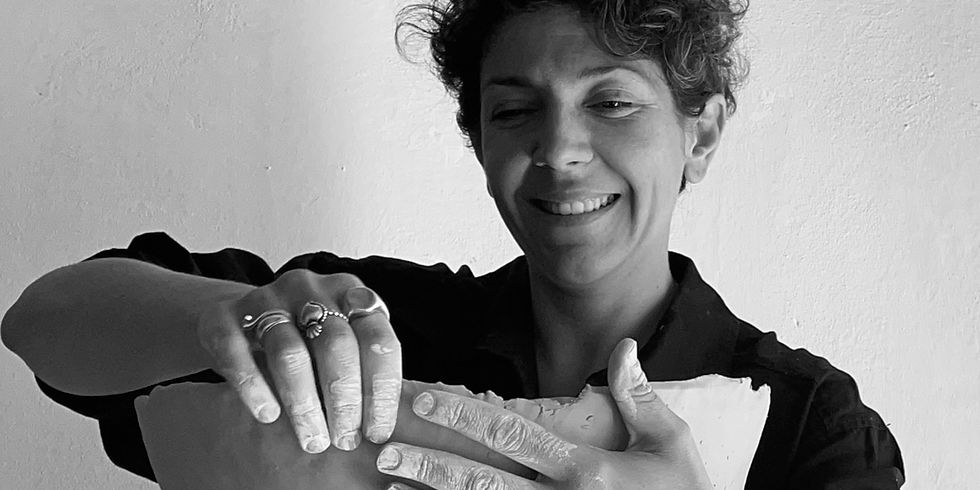
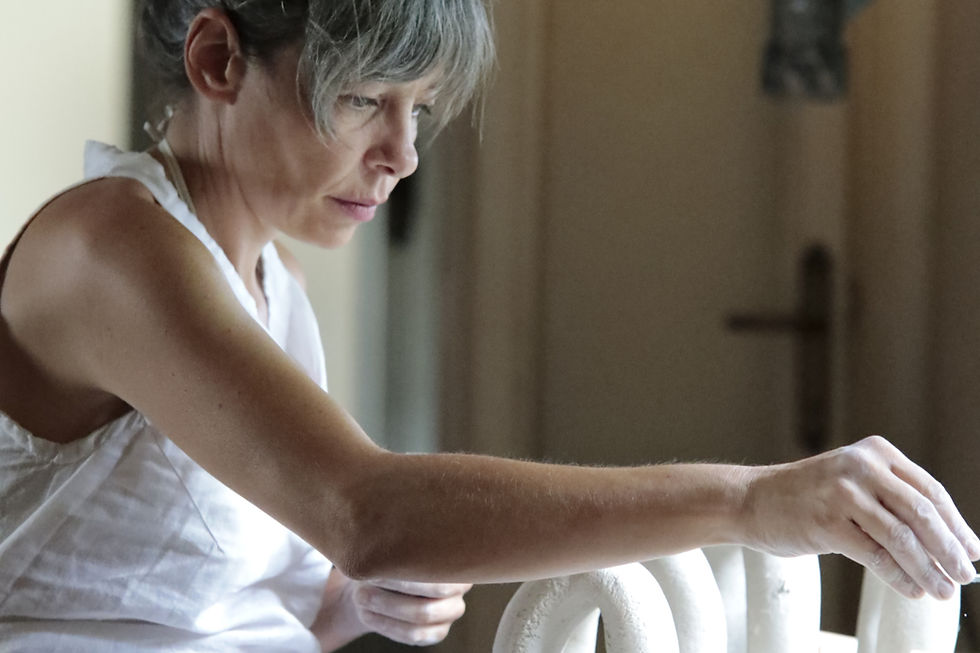
Exploring the Depths of Memory: The Art of Francesca Romana Cicia
Updated: 2 days ago

Francesca Romana Cicia is an Italian artist based in Rome.
Through painting, sculpture, and installation, she explores the need to investigate that hidden place which preserves the fragments of lived experience. Her practice is rooted in depth, reflection, and an attentive listening to matter. Indeed, blue is the color she feels most connected to—a metaphor for thought, intimacy, and the silence of hidden things.
The fragment—namely, a part of the work—refers to a representation of the incompleteness of reality: something broken, yet within this fragmentation a story is concealed, a lived experience that must be remembered. The incomplete part is a piece of truth that invites us to reflect on the totality that escapes our understanding. It is an invitation to seek connections and meaning even in the most fragmentary aspects of experience. Something has been interrupted, and it is up to us to reassemble it. Crystalline
glazes on ceramics represent suspended memories, more or less legible traces of absences that constantly long for reunification.
The artist’s research speaks of fragility, natural vulnerabilities, the delicacy of things and their capacity to break or transform. Memory, finally, is the thread that allows us to recompose the fragments of the past, to give meaning to what has been, and to preserve what would otherwise be lost. It is a subtle and fascinating bond that the artist reconstructs between past, present, and future.
Tell us about your world and way of art, crystalline ceramics, and blue…
What inspires your work?
My work arises from a constant attention to the mechanisms of memory and to what within it is lost, transformed, or left suspended. I am interested in the inevitable presence of voids, since every memory is always incomplete compared to the original lived experience and subject to continuous reshuffling. We often attribute solidity to memories, turning them into personal truths, when they can be fragile constructions made of fragments reassembled by the mind. This ambiguity—between what remains and what is missing, between truth and illusion—is what fuels my research.
How important is the process of making to you?
For me, the process plays a central role; it is the most significant part of the research. The outcome has its importance, but the journey matters even more. It is during the process that intuitions emerge, driven by an initial intention that is examined and deepened along the way.
Are there materials you prefer to work with over others?
Painting was the first language through which I began to express myself and it has remained a constant presence. Only later in life did I approach sculpture, gradually integrating it into my work. Clay was an important discovery: the world of ceramics—where painting and sculpture meet—expanded the directions of my research. Through the use and layering of crystalline glazes, vitreous elements of different colors applied to ceramics, I seek to convey the complexity of memory, exploring its stratified nature, its overlapping residues, and the transparencies that mark both its permanence and fragility.
How do you feel when matter takes a different form from your initial thought?
When matter takes a direction different from the initial thought, it can sometimes become a possibility. As I mentioned before, the process is driven by an intention that sets the path in motion, along which new intuitions may emerge. These do not replace the initial idea but enter in dialogue with it, shifting its boundaries and opening it to new developments. It is within this tension that the work continues to evolve.
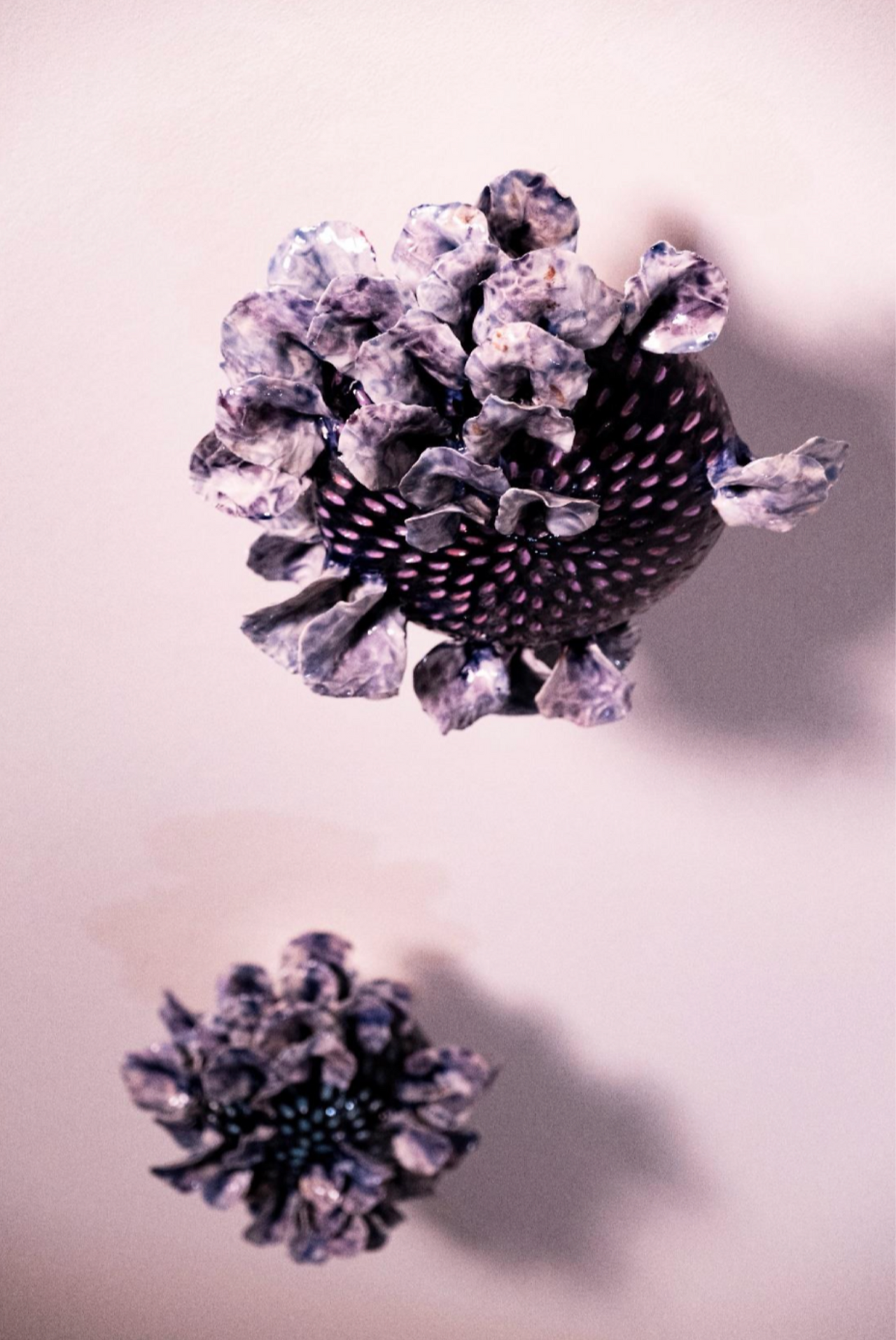
Before It Fades #3, 2025, Crystalline glazes on ceramic. What Remains, 2025, Crystalline glazes on ceramic. Ph. Nicola Russo.
What relationship do you have with the work before and after its realization?
Often, before beginning something new, I imagine its content and form several times. The journey already begins in the mind: it is an important step in preparing myself for its realization. Afterwards, my relationship with the work changes and is never the same. Sometimes I feel a strong closeness to what emerges; other times, a distance surfaces, almost a sense of discomfort. This shift is also part of the process and of how the research develops.
Regarding the fragment and memory, key concepts in your research, do you feel
that ceramics can better represent them?
Ceramics allow me to investigate fragmentation and memory in a more physical way, precisely because of the material’s characteristics: through modeling and breaking, voids, absences, and fragility manifest themselves physically. However, I do not feel that ceramics represent these concepts better than other media. In my work, painting and ceramics coexist without one prevailing over the other, meeting within a single expressive path.
Can ceramics therefore be a symbol that reunifies and, at the same time,
regenerates a fragmented space?
It can be, but rather than as a symbol, ceramics is a medium through which to explore and give form to what is fragmented. Fragments may be rejoined, yet the break remains. In this way, ceramics makes it possible to give body to memory and to reveal its complexity—between what is preserved

Bio
Born in 1994 in Rome, Francesca Romana Cicia lives and works in Rome. She obtained a diploma in Decoration after completing the specialist two-year programme at the Accademia di Belle Arti di Roma.
Her research examines the mechanisms of reception and resistance of lived experience within memory, working across painting, sculpture, and installation.
Selected exhibitions include: Materia Nova. Roma nuove generazioni a confronto, curated by Massimo Mininni, Galleria d’Arte Moderna, Rome (2021); Bagni Misteriosi, cabine d’artista 2, curated by Giacomo Guidi, Ostia (2022); MVM, Vuoto, project by Cristallo Odescalchi, Rome (2023); LIMEN, ExGarage, Rome (2023); Canti Elettrici, Ferentino (2024); Si è seduto il vento, curated by Gemma Gulisano, CityLab971, Rome (2024); Quattrocantesimo, Palazzo Costantino, Palermo (2024); Umwelten-ambienti, curated by Valeria De Siero, Parco di Veio, Rome (2024); Evo Obliäto, curated by Laura Catini, Spoltore (2025).
Explore the Collection
A curated selection of works by Federica Paglia will be developed in dialogue with the research documented in this Journal entry. These works will be presented as part of future Avant Craft curatorial projects.
Continue Exploring
Every article published in the Avant Craft Journal contributes to a broader conversation about contemporary craft, ceramics, material and design.
Stay Connected
Receive new interviews, visual narratives and stories on contemporary craft, ceramics and design directly from the Avant Craft Journal.