Ceramic Presences: Chiara Camoni at the Italian Pavilion, Venice Biennale 2026
by Valeria Zerbo and Amalia Di Lanno
Photography © Avant Craft Craft
At the Venice Biennale 2026, Italian artist Chiara Camoni presents Con te con tutto, a project curated by Cecilia Canziani that transforms the Italian Pavilion into a landscape of ceramic figures, natural materials and collective encounters.

Chiara Camoni, Con te con tutto, installation view of the second Tesa, with reclining ceramic sculptures and low platforms
The experience of the Italian Pavilion begins before entering it.
Located at the far end of the Arsenale, the pavilion forms part of one of the most significant productive landscapes in the history of Venice. Once the manufacturing centre of the Serenissima, the Arsenale brought together materials, specialised knowledge and thousands of skilled hands to build, repair and equip the Venetian fleet.
The Italian Pavilion occupies the Tese delle Vergini, two vast nineteenth-century industrial halls originally used to store fuel. Nearby, the monumental Gaggiandre open directly onto the water. Built in the sixteenth century as covered docks for the construction and maintenance of ships, their vast roofs, brick arches and reflected surfaces preserve the memory of a place in which making was fundamental to the identity of Venice.
This history gives particular resonance to a pavilion centred on material transformation, manual knowledge and collective practice.
Con te con tutto, Chiara Camoni's project for the Italian Pavilion, unfolds as a single installation across the two Tese delle Vergini.
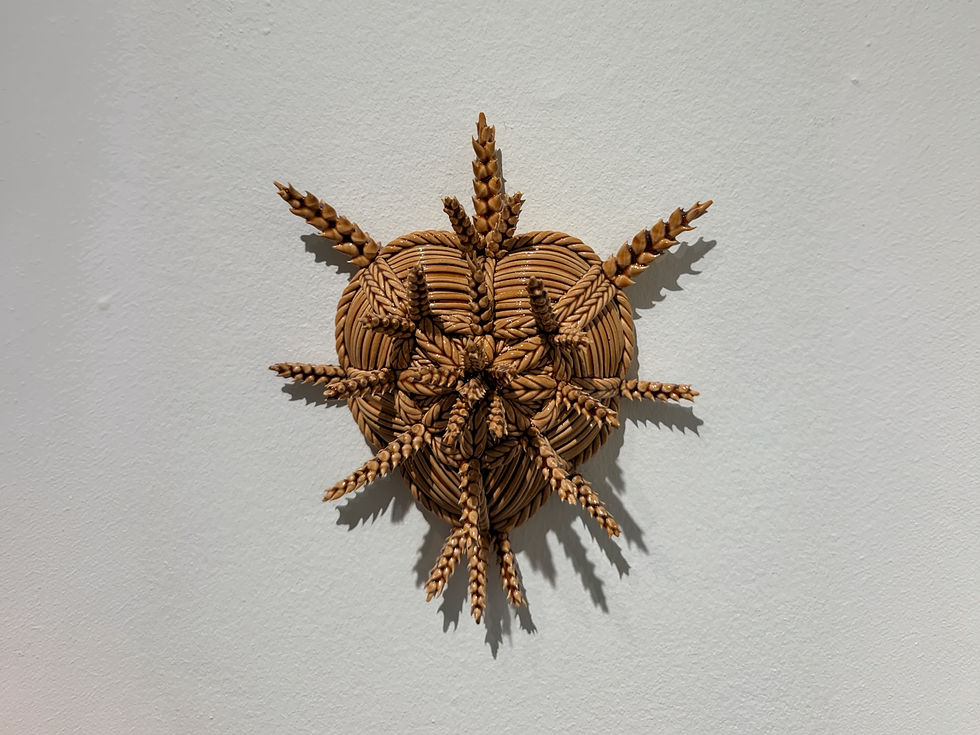
Camoni's practice encompasses drawing, sculpture and collective forms of making, with ceramics occupying a central place in her work. She combines clay with ashes, plants, flowers, stones, discarded materials and objects gathered from her surroundings, allowing the natural, human and artificial to coexist within the same form.
Transformation begins within the material itself. Camoni creates her glaze using earth, plant matter, shells and bones, crushed and applied to the clay before a second firing. The final colour cannot be fully controlled, emerging through the interaction of matter, heat and time.
The decision to place her ceramic sculptures at the centre of Italy's national presentation is significant. At one of the world's most prestigious international art events, ceramics is presented not as a peripheral or exclusively functional practice, but as a primary language of contemporary art—capable of carrying sculptural, conceptual and collective meaning.
Chiara Camoni, Con te con tutto, installation views of the first Tesa, Italian Pavilion, Venice Biennale 2026.
In the first Tesa, twenty-four human-scale figures emerge from the darkness like guardians. Among them are the Colonne, Sisters and Daimons, sculptural presences that suggest a world suspended between humanity, mythology and nature.
Archaic yet contemporary, their bodies incorporate vegetal elements, plastic fragments, remnants and found objects. From a distance, we initially perceive their silhouettes: a gathering of upright, undefined presences within the vast space.
Their identities remain elusive.
As we move closer, it seems that each face comes into focus only at a particular distance. The body is perceived first; the individual presence reveals itself gradually. We must approach each sculpture closely enough to recognise its features, but also find the position from which they can be seen as a whole.
The encounter is completed through movement.
Anthropomorphic ceramic figure and detail by Chiara Camoni, revealing intricate modelling and organic materials. Italian Pavilion, Venice Biennale 2026.
This progressive approach suggests that neither an artwork nor reality can be understood immediately or from a fixed point of view. Knowledge requires proximity, time and attention. We must adjust our position, accept a degree of uncertainty and allow what stands before us to reveal itself slowly.
Camoni's figures do not ask simply to be observed. They ask to be met.
Together, they form a forest—a place that, within the Western imagination, has often represented the unknown and the irrational, inhabited by witches, Bacchantes, wolves and beings that resist established order.
For Camoni, however, the force of art does not lie in being inherently good or curative, but in its capacity to transform. Transformation can be generative, but it can also disturb us. When someone different enters our space, the environment we believed we knew begins to change. Encounter does not leave the world—or those participating in it—unchanged. The figures invite us to enter a shared space and consider how living alongside other bodies, materials and forms of life might transform our own position.
From Individual Presence to Collective Space
The second Tesa changes orientation and atmosphere. Darkness gives way to natural light, while the vertical encounter with the ceramic figures opens into a more horizontal and domestic landscape.
Tables, cabinets, surfaces and places for resting or gathering transform the pavilion into a space of exchange. The domestic is extended into the public realm, and the individual experience of the first room gradually becomes a collective one.
This transition reflects Camoni's wider practice. Family members, friends, neighbours, students and collaborators have entered her working processes, expanding the idea of authorship beyond the isolated artist. Creation becomes something shared: knowledge is transmitted through gestures, materials, conversations and time spent working together.
The presence of numerous ceramic vessels and objects reinforces this sense of collective activity. Different scales, shapes and surfaces reveal the individual character of making, while their arrangement suggests a wider conversation between objects and the hands that created them.

Ceramic vessels and objects arranged in the second Tesa of Con te con tutto, Italian Pavilion, Venice Biennale 2026
Within the former productive landscape of the Arsenale, this collective dimension acquires a particular resonance. The historical memory of specialised hands working together is met by a contemporary artistic practice in which making remains a form of embodied knowledge and relationship.
Here, craftsmanship is inseparable from thought. The hand does not simply execute an idea already defined; it participates in discovering what the work might become. Just as the glaze finds its colour through a process the artist cannot entirely govern, an encounter produces transformations that cannot be fully anticipated.
In a Biennale shaped by movement and the rapid consumption of images, Con te con tutto asks us to slow down. It reminds us that an encounter requires presence—and that seeing is not yet the same as knowing.
Exhibition Details
Con te con tutto , Chiara Camoni
Curated by Cecilia Canziani
Italian Pavilion, Biennale Arte 2026
Tese delle Vergini, Arsenale, Venice 9 May–22 November 2026
For further information, visit the official Italian Pavilion website.
Explore More
Discover more perspectives in the Avant Craft Journal