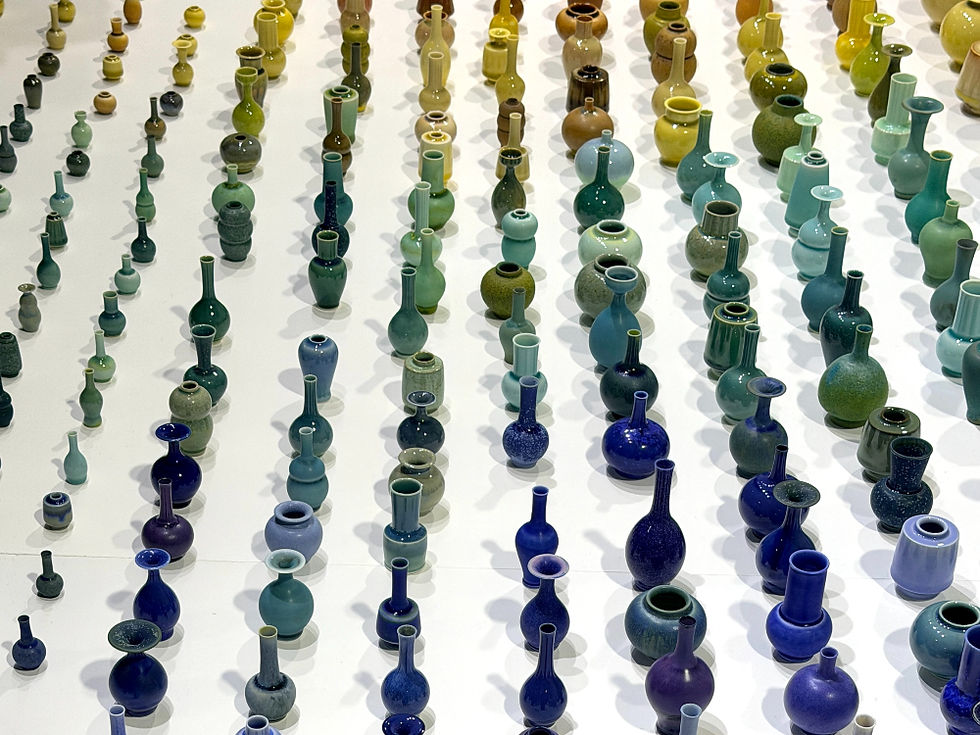
British Art Fair 2026: A Visual Narrative from Saatchi Gallery
Updated: 7 days ago
Text by Valeria Zerbo and Amalia Di Lanno
Photos by Amalia Di Lanno
British Art Fair returned to Saatchi Gallery this September, bringing together more than 70 galleries and a broad panorama of Modern and Contemporary British Art. Twentieth-century masters appeared alongside contemporary practices, while Spotlight: Contemporary and Spotlight: Digitalism expanded the conversation towards new materials and forms of image-making.
Moving through the fair, certain ideas seemed to recur across very different practices: nature transformed through material, landscapes shaped by memory, the human figure reduced and reconstructed, and the persistent trace of the hand.
This Visual Narrative follows some of these encounters.
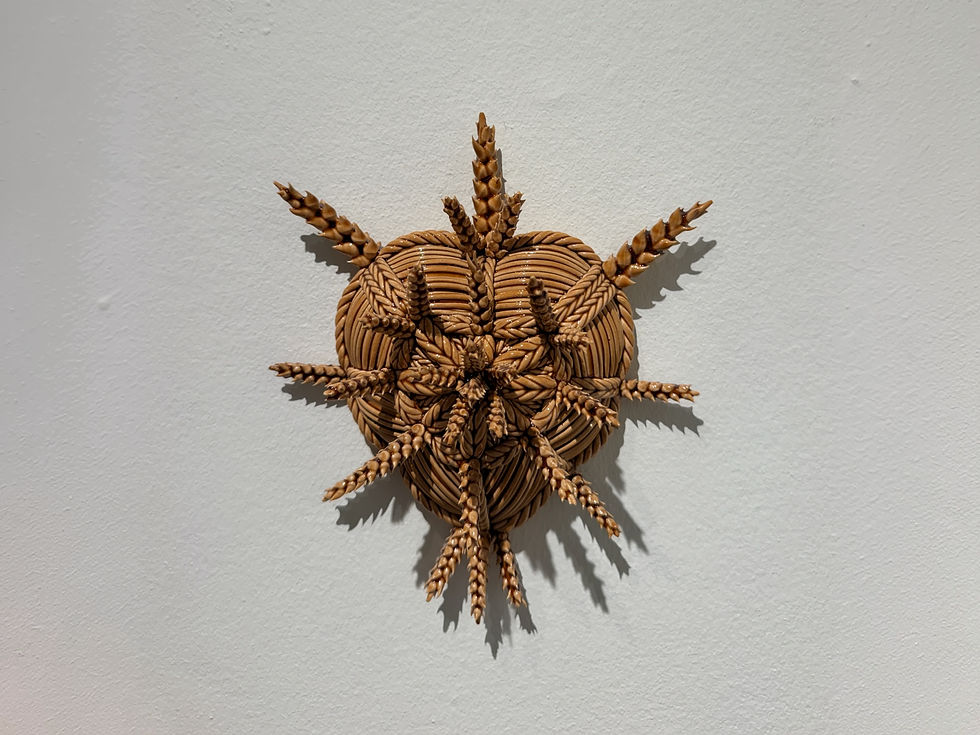
Malene Hartmann Rasmussen, Corn Dolly Heart (Medium), 2018, Glazed earthenware. James Freeman Gallery
Clay takes on an almost botanical life in the work of Danish-born artist Malene Hartmann Rasmussen, whose sculptural practice draws on nature, folklore and imagined worlds.
Repeated ceramic elements accumulate around a dense centre: wheat-like stems extend outwards while coils, leaves and small hand-modelled forms overlap and intertwine. There is something simultaneously ordered and unruly about the composition.
The transformation of clay is particularly compelling. A material associated with weight and earth becomes unexpectedly intricate and organic, moving between sculpture, ornament and an imagined fragment of the natural world.
In the work of Emma Todd, material gives way to atmosphere. Muted browns, dusty pinks and deep shadows move gradually across the surface, with few recognisable forms to anchor the eye.
The image seems caught somewhere between abstraction and landscape — as though something were slowly emerging through mist or memory. Rather than describing a place, colour creates the sensation of one.
A moon hangs above a dark clearing in Gill Rocca's circular landscape. Rocca creates imagined, uninhabited places through carefully layered oil paint, drawing on observation, memory and imagination.
Trees emerge through darkness before disappearing into mist, while a small point of light gives the composition its orientation. The circular support intensifies the sense of looking into another space.
It is recognisable without being identifiable: not so much a depiction of somewhere as the recollection of having once been somewhere.
Left: Gill Rocca, Figment CXXVI, 2026, Oil on birch ply, 30 cm diameter. GBS Fine Art. Right: Emma Tod, Soft heavy (428.5 parts per million), 2026, Oil on cradled aluminium panel, 70 × 60 cm. GBS Fine Art
Felicity Powell’s Coral Tears draws the eye into an intimate, almost microscopic world. Made in wax on mirror glass, the small circular work combines delicacy with a slightly uncanny, organic presence. Powell’s practice often moved between myth, science and belief, and here the reflective black surface makes the pale wax forms appear suspended, almost specimen-like. The work was presented by Richard Saltoun Gallery at British Art Fair 2026
The unmistakable figures of Lynn Chadwick introduce a very different relationship between material and the human body. At British Art Fair, Pangolin London dedicated its entire stand to Chadwick, presenting works spanning four decades of his career.
Angular torsos stand on elongated legs, while geometric heads reduce individual identity to elementary forms. Bodies become planes, legs become supports and heads become geometry.
Yet despite this reduction, the figures retain a strong sense of presence. A slight inclination of a body, the distance between two figures or the direction in which they appear to face becomes enough to suggest a relationship.
Top left: Richard McVetis, Orbit, 2025 and Juliette Bigley, Conjunction: Black Sphere, 2022. Cavaliero Finn. Top right: Lynn Chadwick's works. Pangolin London. Bottom left: Felicity Powell, Coral Tears, c. 2009, Wax on mirror glass, 20 cm diameter. Richard Saltoun Gallery. Bottom right: Jemma Gowland, Your Move, 2026, Porcelain, gold lustre and wood; includes chess pieces. Cynthia Corbett Gallery
At Cavaliero Finn, the works of Juliette Bigley and Richard McVetis create a particularly quiet dialogue.
Bigley works with hand-formed metal, while McVetis uses stitch and textile to investigate time and repetition. Seen together, their works share an economy of form: circle, line, sphere, surface.
In McVetis's work, repeated stitches accumulate slowly across the textile. Beside it, Bigley's metal sculpture introduces a different kind of material memory. The apparent precision of its geometry still contains the physical process through which the metal has been shaped.
Material here is not simply a means of producing form. It carries evidence of time, pressure, repetition and touch.
Two crowned children sit opposite one another across a chessboard in Jemma Gowland's ceramic sculpture.
Working with porcelain and mixed media, Gowland uses the familiar language of the figurine to explore childhood and the expectations surrounding girls and women.
The initial impression is almost playful. White porcelain, miniature chess pieces and gleaming gold crowns evoke the preciousness traditionally associated with decorative ceramics. But the scene becomes more ambiguous the longer we look.
Porcelain, with all its associations of delicacy and decoration, becomes the medium for a small psychological drama.

Left: Lou Nathanson. Right: Lynn Chadwick, Walking Cloaked Figures I, Osborne Samuel.
Bottom: Robin Kane
The transition into Spotlight: Digitalism, curated by Rebekah Tolley, changes the visual language of the fair. Bringing digital practices into dialogue with Modern and Contemporary British art, the section explores new approaches to image-making and the possibilities offered by digital technologies.
Within Digitalism, international curatorial platform AVGD Gallery presented a nine-artist collective under the theme Systems of Belief.
Among the artists presented, Robin Kane uses generative AI to explore memory, perception and distortion. Her images inhabit an ambiguous space between the recognisable and the uncanny, where faces and bodies shift, multiply and become layered.
In the work of Lou Nathanson, figures similarly appear fragmented and reconstructed through layers of architectural and photographic imagery. Faces repeat, buildings intersect with bodies, and silhouettes are interrupted and reassembled.
Moving into Spotlight: Contemporary, John M. Robinson’s presentation with "A Modest Show" turns painting into a performative act. The artist covers his own head with flowers and photographs himself, transforming his body into a temporary composition somewher
e between self-portrait and still life. These photographs then become the starting point for his paintings, where the face disappears beneath an abundance of flowers.
This movement between performance, photography and painting extends into the installation itself. The works are shown alongside still lifes and a small timber shed covered with real blooms, supplied by WasteToPlate Sustainable from flowers otherwise destined to be discarded. Inside the shed, the photographic image reappears on screen, revealing another stage in the process.
Real and represented flowers coexist throughout Modest Show: worn on the body, captured through photography, translated into paint and finally returned to physical space. While the painted flowers remain fixed, the living blooms surrounding the shed inevitably change and fade, introducing ideas of time and impermanence into the installation.
Left: John M. Robinson, The Allotment Shed (Installation with Flower Head Video Performance), 2024–2026 A Modest Show. Right: John M. Robinson, Large Allotment Flower Head, 2025. Oil on canvas
Across British Art Fair, the distance between Modern British art and contemporary practice often felt smaller than expected.
Clay becomes botanical. Metal becomes body and structure. Stitch gives duration a physical presence. Porcelain shifts from decoration towards narrative. Digital fragments become a new form of collage. Oil paint turns colour, light and shadow into atmospheric landscapes suspended between memory and imagination.
The language changes and the materials evolve, but the relationship between hand, material, image and experience remains remarkably persistent.