Royal Academy Summer Exhibition 2026: Contemporary Art, Craft and Collectible Design
Updated: Sep 7
Text by Amalia Di Lanno and Valeria Zerbo
Photos by Amalia Di Lanno
Each summer, the Royal Academy Summer Exhibition opens its doors to one of the world's most anticipated open-submission exhibitions. The Summer Exhibition 2026 brings together around 1,700 works across 13 galleries, celebrating contemporary painting, sculpture, architecture, photography, printmaking and contemporary ceramics. The exhibition offers a compelling overview of today's artistic landscape, where contemporary craft, collectible design and fine art increasingly intersect.
Coordinated this year by artist Ryan Gander, together with a committee of seven Royal Academicians, the exhibition explores the theme Interconnectedness. As Gander explains in the exhibition catalogue, the exhibition celebrates "ideas of entanglement, as well as the unexpected and fortuitous connections and associations between disparate things, no matter how abstract or illogical. These connections are proof that, as humans, our creations often hold more commonality than separation." Reflecting this vision, works from different disciplines are deliberately integrated throughout the galleries, encouraging dialogue between painting, sculpture, architecture and craftsmanship, while revealing unexpected relationships between materials, ideas and artistic practices.

As always, the result is ambitious, eclectic and unapologetically dense. Critics have responded with mixed views: some have praised Gander for introducing unexpected juxtapositions and a greater sense of curiosity than in previous editions, while others argue that the sheer quantity of works often overwhelms the exhibition's curatorial intentions. Nevertheless, the exhibition remains one of London's most significant contemporary art exhibitions, offering a unique opportunity to discover both internationally recognised practitioners and emerging independent artists.
Within this complexity, several galleries emerge as particularly memorable. The room curated by Royal Academician Eileen Cooper has been widely recognised for the strength of its artistic selection and the dialogue established between works, while Katherine Jones's gallery stands out as the clearest interpretation of this year's theme, offering one of the exhibition's most coherent curatorial narratives. Together, these galleries demonstrate how thoughtful curation can illuminate the connections between materiality, artistic process and contemporary visual culture.
Rather than attempting to experience every work equally, the Summer Exhibition rewards a slower, more selective approach. It is an exhibition of discoveries, where contemporary artists, ceramic artists, designers and makers sit alongside established names, and where unexpected encounters often become the most memorable part of the visit.
Rather than offering a comprehensive review, this visual narrative follows our journey through the galleries, bringing together the works and artistic conversations that resonated most with us.
Installation view: Gallery VI and Gallery V, Royal Academy Summer Exhibition 2026
Gallery I — Gardens and Places of Creativity
Curated by Katherine Jones RA, the opening gallery explores gardens, allotments and cultivated landscapes as places of creativity, community and experimentation. Bringing together painting, sculpture and contemporary ceramics, the selection celebrates the beauty of everyday nature while revealing how organic forms continue to inspire contemporary craft and artistic practice.
Among the works that particularly caught our attention was Katie Gabra's Karat, a playful ceramic sculpture that transforms humble bean pods into gilded objects of quiet value. In contrast, Anya Kashina's Already and Not Yet explores organic forms through expressive abstraction, demonstrating how colour and gesture can evoke the rhythms of the natural world. Together, the works reflect the gallery's invitation to look more closely at familiar forms, showing how craftsmanship and artistic experimentation can elevate the everyday into something quietly extraordinary.
Gallery II — Colour and Abstraction
Also curated by Katherine Jones RA, Gallery II moves away from the botanical imagery of the opening room towards a more abstract exploration of colour, printmaking and material experimentation. Alongside expressive painting and sculpture, Carla Wright's Carrier Bag reimagines an everyday object through glazed ceramic, demonstrating how contemporary artists continue to blur the boundaries between contemporary craft, sculpture and design. Together, the works reveal how abstraction and familiar forms can coexist, inviting new ways of looking at the ordinary.
Large Weston Room — Drawing in Three Dimensions
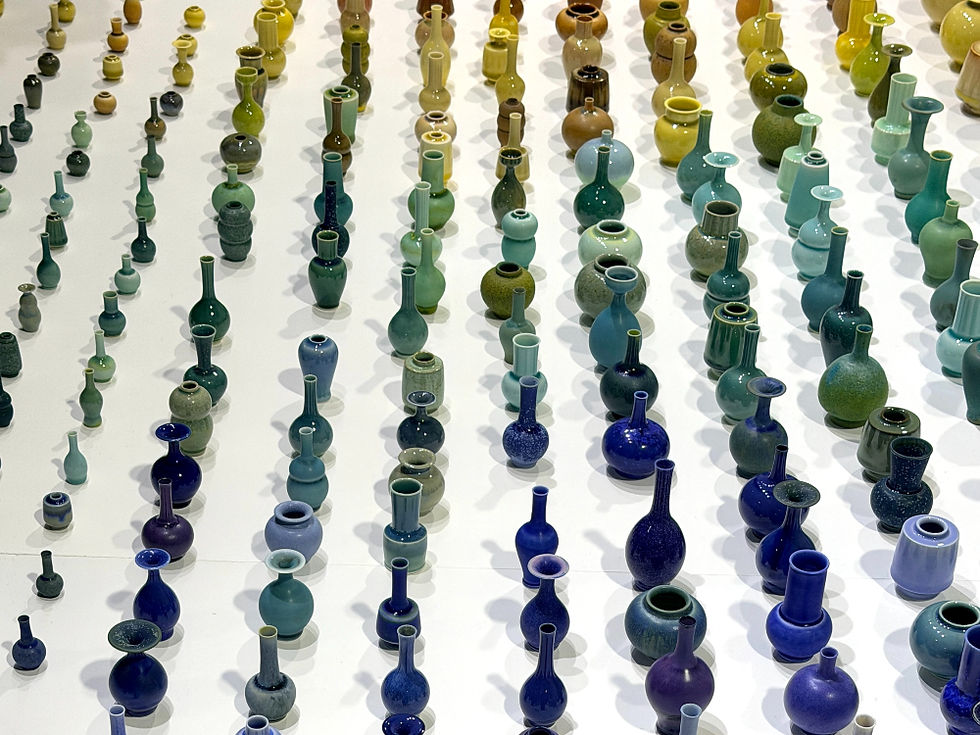
Curated by Oona Grimes RA, the Large Weston Room expands the idea of drawing beyond paper, bringing together sculpture, embroidery, prints and painting through a shared interest in line, gesture and process. Cathie Pilkington's Painted Inventory transforms everyday objects into a theatrical installation that blurs the boundaries between sculpture and narrative, while Eva Rothschild's Still Life, a series of glazed ceramic multiples, introduces a quiet dialogue between repetition, form and contemporary ceramics. Together, the works reveal how drawing can extend into space, material and object, encouraging visitors to discover unexpected connections across different media.
Image on the top left: Emma Collins, Where the Flowers Grow, giclee print. Gallery VII. Image on the bottom left: Monica Denevan, Gemini, Burma, pigment photograph from negative. Gallery VII. Main work on the right: Sebastian Alabaster, Collective Field, acrylic. Gallery V, Royal Academy Summer Exhibition 2026
Small Weston Room — Light and Playfulness
Selected by Ryan Gander RA, the Small Weston Room revolves around themes of light, illusion and playfulness. Works by Ron Arad, James Lomax and Nigel Coates blur the boundaries between image, object and perception, encouraging visitors to question what they see while embracing curiosity and visual wit.
Gallery III — Interconnectedness
Also curated by Ryan Gander RA, Gallery III brings the exhibition's central theme of Interconnectedness into focus. A white architectural "line of passivity" runs through the space, physically and conceptually connecting works across the gallery while encouraging unexpected relationships between generations, disciplines and artistic practices. Joan Jonas's Snake Drawing I, created as part of her performance The Shape, The Scent, The Feel of Things (2005), reflects this expanded understanding of drawing as a performative and spatial act. Holly Hendry's Footnotes (Blu-Tak) combines steel, ceramic, jesmonite and bronze in a sculptural composition that explores materiality through the meeting of handcrafted and industrial processes. Together, the works exemplify the gallery's dialogue between generations, disciplines and artistic practices, reinforcing Gander's vision of a richly interconnected contemporary art exhibition.
Image on the left: Carla Wright, Carrier Bag, glazed ceramic. Gallery II. Image in the middle: Installation view Gallery II. Image on the right: Anya Kashina, Already and Not Yet, acrylic. Gallery I, Royal Academy Summer Exhibition 2026
Gallery V — Narratives Through Juxtaposition
For her first Summer Exhibition hang, Goshka Macuga RA builds Gallery V around visual interconnectedness, arranging works in carefully considered groupings that encourage unexpected associations across media and artistic practices. Marina Abramović's The Kitchen VIII, from the series The Kitchen, Homage to Saint Therese, presents a contemplative photographic image that reflects on ritual, stillness and the body. Elsewhere in the gallery, Sebastian Alabaster's Collective Field explores colour and abstraction through layers of acrylic paint, creating a vibrant composition that rewards prolonged observation. Among the artists featured in the gallery is also the Italian artist Carolina Mazzolari, with the mixed media work LINE VII – BLUE. Together, these diverse approaches reflect Macuga's interest in allowing distinct artistic voices to coexist while inviting visitors to construct their own connections.
Gallery VI — Material Dialogues
Curated by Farshid Moussavi RA, Gallery VI explores the relationship between architecture, sculpture and material experimentation. Rather than organising works by discipline, the gallery brings together diverse artistic practices through shared concerns with structure, scale and surface. The installation reveals a carefully balanced dialogue between two- and three-dimensional works, encouraging visitors to move through the space and discover unexpected connections between materials, forms and processes. Reflecting the exhibition's theme of Interconnectedness, the gallery demonstrates how contemporary art and contemporary craft can enrich one another through material exploration.
Image On the left: Cathie Pilkington RA, Painted Inventory, wooden hanging racks, painted papers, linen, ribbon curtains. Large Weston Room Gallery. Image in the middle: Installation view Gallery V. Image on the right: Harriet Mena Hill, Crossing Points: The Aylesbury Fragments, acrylic on salvaged concrete. Gallery VIII, Royal Academy Summer Exhibition 2026
Gallery VII — Community Through Art
The first of two galleries curated by Eileen Cooper RA, Gallery VII embraces the spirit of an art school, where different generations, disciplines and perspectives coexist. Portraiture, sculpture and painting are brought together to create conversations across media, revealing how unexpected encounters between works can generate new meanings. Emma Collins' Where the Flowers Grow captures the gallery's sense of imagination and observation through a richly layered composition, while Monica Denevan's Gemini, Burma offers a quieter reflection on place and human experience through photography. Together, the works demonstrate the openness and diversity that characterise Cooper's curatorial approach.
Gallery VIII — Looking with Empathy
In the second gallery curated by Eileen Cooper RA, themes of memory, companionship and the human figure unfold alongside large-scale abstraction and textile works. Intimate portraits, commemorative pieces and immersive paintings create a space that invites quiet reflection while celebrating the emotional power of contemporary art. Harriet Mena Hill's Crossing Points: The Aylesbury Fragments transforms salvaged concrete into a meditation on place, memory and urban change, while Jamie Quade's Before Noon, After Noon combines paper and brass in a delicate exploration of time, materiality and making.
Gallery IX — Sea, Colour and Connection
Curated by Eileen Cooper RA and Katherine Jones RA, Gallery IX brings the exhibition to a thoughtful close through a vibrant exploration of colour, landscape and material expression. Continuing the theme of Interconnectedness, the gallery brings together diverse artistic practices in a hang that feels both dynamic and cohesive. It offers a fitting conclusion to the Summer Exhibition, celebrating the dialogue between disciplines while reinforcing the enduring relationship between art, craft and contemporary visual culture.
Image on the top left: Jamie Quade, Before Noon, After Noon, paper and brass. Gallery VIII. Image in the middle left: Katie Gabra, Karat, imitation gold leaf. Gallery I. Image on the bottom left: Installation view Gallery VII. Image on the top right: (top) Divya Balivada, Folding into itself, oil; (bottom) Victoria Coombes, Violet Khandro, oil and gesso on wood. Gallery I. Image in the middle right, on the shelf: Eva Rothschild, Still Life, thirty-two glazed ceramic multiples. Large Weston Room Gallery. Image on the bottom right: Holly Hendry, Footnotes (Blu-Tak), steel, ceramic, jesmonite, bronze, paint. Gallery III, Royal Academy Summer Exhibition 2026.
This visual narrative does not seek to document the Royal Academy Summer Exhibition 2026 in its entirety. Instead, it offers a personal reading of the exhibition through a carefully curated selection of works and images that resonated most strongly with us. The photographs have been deliberately chosen and arranged for the visual relationships they establish with one another, creating a narrative that extends beyond the physical sequence of the galleries.
While each work is discussed within the context of the gallery in which it is exhibited, the visual editing of this essay invites new dialogues to emerge across rooms, disciplines and materials. This reflects the very spirit of Interconnectedness, where meaning is shaped not only by individual works but also by the unexpected relationships created between them.
Ultimately, the exhibition reminds us that contemporary art, contemporary craft and collectible design are increasingly defined by exchange rather than separation. Through this visual narrative, we hope to encourage the same kind of slow looking and curiosity that makes the Summer Exhibition one of London's most rewarding artistic experiences.
Continue exploring
Every article published in the Avant Craft Journal contributes to a broader conversation about contemporary craft, ceramics, material and design.
Stay Connected
Receive selected Journal stories, artist interviews and visual narratives, together with occasional updates on Avant Craft exhibitions, projects and events.