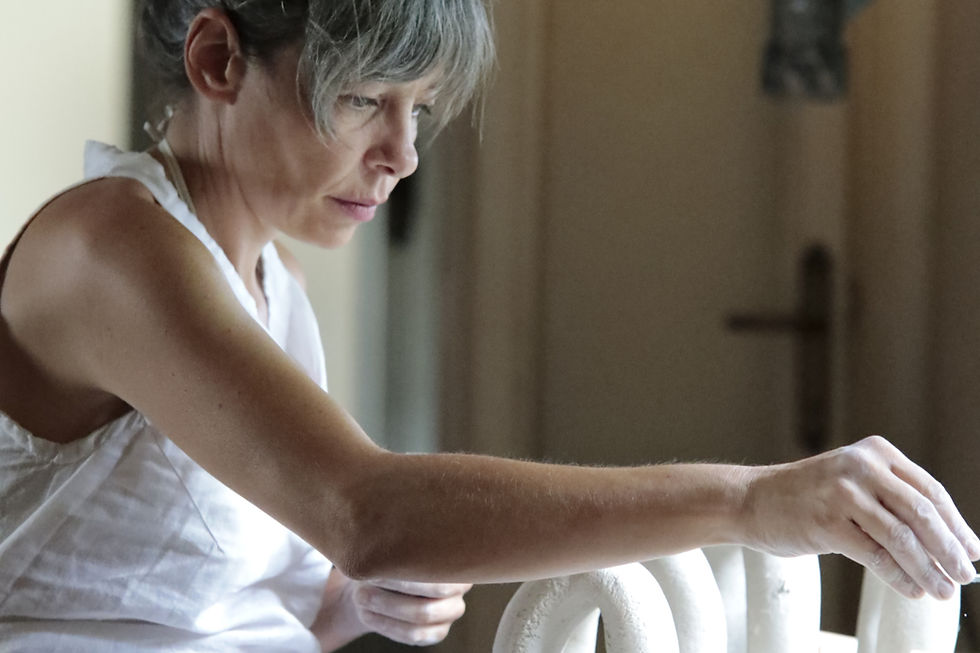
Teresa Lobelia D’arienzo. Staging Clay: Ceramics as Scenography
Updated: Sep 5
Interview by Valeria Zerbo and Amalia Di Lanno
Photos: courtesy of the artist
There is a sense of suspension in the work of Teresa Lobelia D’Arienzo, an Italian ceramic artist whose practice offers a distinctive perspective on contemporary Italian ceramics.
Forms appear to balance, almost precariously, while surfaces reveal the gestures through which they have been constructed. Clay is layered, assembled and allowed to retain traces of the process, creating sculptural ceramics in which fragility and strength, control and unpredictability continuously coexist.
Working between Arezzo and Rome, D’Arienzo has developed her ceramic practice alongside a career in costume design for international film productions. After studying at the Academy of Fine Arts in Florence, she graduated in Costume Design from the Centro Sperimentale di Cinematografia in Rome. These apparently distinct disciplines have gradually become two interconnected languages, shaping her understanding of form, material and narrative.
Much like costume contributes to the construction of a character, her ceramic works develop a presence of their own. Familiar archetypes — particularly the vessel and the amphora — remain recognisable, yet are transformed through expressive surfaces, unexpected constructions and delicate points of balance.

In our conversation, Teresa reflects on the dialogue between ceramics and cinema, the role of intuition and imperfection in her process, and her relationship with Italian ceramic tradition. At the centre of her practice is an understanding of clay as an active material: one capable of preserving the memory of gesture while continually opening new possibilities for form. Her research contributes to the evolving landscape of contemporary Italian ceramics, where material experimentation, inherited knowledge and contemporary artistic language remain in constant dialogue.
After studying at the Academy of Fine Arts in Florence, your practice developed between ceramics and cinema. How have these different languages influenced your approach to form, texture and narrative?
They have always been two languages that nourish one another and that, over time, have shaped my own idea of aesthetics. In both cases, I begin with a single element in order to construct a narrative, a character, a presence — that of the character or of the artwork — which describes a life through form, colour and construction.
The final form is never simply a formal solution, but points towards a narrative and evocative dimension, capable of activating a perceptual experience. In the same way, surfaces and textures do not have an ornamental function; they preserve the memory of the process and make visible the dialogue between gesture and material.
Your work brings together raw and refined elements, giving rise to unexpected forms and balances. How has this research evolved over time, and which aspects are you interested in exploring further today?
My research comes from the desire to work with a raw, primary material, challenging the limits imposed by thickness and resistance in order to achieve a refined essentiality — an elegance capable of preserving the strength and power of lightweight forms, crossed by breaks, pauses and improvisations.
These are traces of a process that remains visible and continues to inhabit the work, creating a constant tension between control and what happens unexpectedly.
Over time, I have allowed these elements to find their own freedom of movement within a space of discovery, where the material itself — clay — guides the expressive possibilities and continually redefines the outcomes of the research. I continue to allow the process to guide me, as a generative force for new relationships and new meanings.
Amphora 11–12, Teresa Lobelia D’Arienzo Twist together detail, Teresa Lobelia D'arienzo
On the left: Amphora 11–12, 2025, Teresa Lobelia D’arienzo. On the right: Detail from twist together, 2025, Teresa Lobelia D’arienzo
You describe your creative process as intuitive. How does a new work begin, and how do you know when a piece has reached its natural conclusion?
My process is intuitive because it is the technique itself — the mistakes and the different stages of construction — that suggests not new forms, but new ways of giving expression to the same forms.
Over time, the forms that are particularly important to me — vessels suspended on small bases — have repeated themselves and continue to reappear, but through different methods of construction, in a continuous process of regeneration.
It is not the form that changes, but the way in which material and process allow it to emerge.
Your works occupy a suspended space between sculpture and function, inviting an experience that is not only visual but also tactile. What kind of relationship do you hope develops between the object and the person who lives with it?
The relationship between sculpture and function remains deliberately suspended, at that point of balance that I like to find when I fit different pieces together.
My objects inhabit that in-between space: the place where things happen, where imagination opens up and where a relationship with the viewer is established. It is a relationship made of wonder, hesitation and a subtle sense of unease that encourages us to slow down our gestures and to look more consciously.
When faced with a fragile object, we instinctively change the way we inhabit the world: our movements become slower, the body measures distances and the gaze becomes more focused. It is precisely this transformation in behaviour that interests me.
Foresta di tenere ombre, fragilità e solidi legami, Teresa Lobelia D’Arienzo he Space Between, Teresa Lobelia D’Arienzo. culptural ceramic vessel by Teresa Lobelia D’Arienzo Meraviglia series, Teresa Lobelia D’Arienzo.
Top Left: Foresta di tenere ombre, fragilità e solidi legami, 2025, Teresa Lobelia D’arienzo. Top Right: The Space Between, 2025, Teresa Lobelia D’arienzo. Bottom Left: Clusters, 2025 by Teresa Lobelia D’arienzo. Bottom right: Meraviglia series, 2026, Teresa Lobelia D’arienzo
Italian ceramic tradition carries an extraordinary heritage. How do you relate to this legacy, and how do you bring it into a contemporary language?
For me, tradition is an existing language that I do not choose to reinterpret, but rather allow to speak within a new and different context.
My forms, techniques and materials belong to a shared body of knowledge that I try to shift into an unexpected context, where they can generate new interpretations and new possibilities for relationships, always moving within that subtle distance between what we recognise and what we discover.
Looking ahead, which directions of research or experimentation would you like to explore in the coming years?
I would like to apply my research to figurative sculpture, bringing the themes that have always run through my work into the presence of the body, without pursuing anatomical virtuosity.
I am not interested in the figure as an exercise in representation, but as a place where material can continue to speak of fragility, balance, memory and wonder.

Biography
Teresa Lobelia D’Arienzo studied at the Academy of Fine Arts in Florence and later graduated in Costume Design from the Centro Sperimentale di Cinematografia in Rome.
She lives and works between Arezzo and Rome. Alongside her artistic practice, she collaborates on international film productions in the field of costume design, an experience that informs her exploration of the language of form and the construction of identity as a narrative device.
Teresa’s artistic research explores the expressive potential of clay, understood as a material capable of preserving the memory of gesture while revealing an ongoing process of transformation. Through essential forms and layered surfaces, her works exist in a suspended state where adhesion and detachment, balance and fragility coexist without ever fully resolving. Her practice seeks to establish a relationship with the viewer founded on wonder, awe and fascination.
Explore More
Every article published in the Avant Craft Journal contributes to a broader conversation about contemporary craft, ceramics, material and design.
Stay Connected
Receive new interviews, visual narratives and stories on contemporary craft, ceramics and design directly from the Avant Craft Journal.