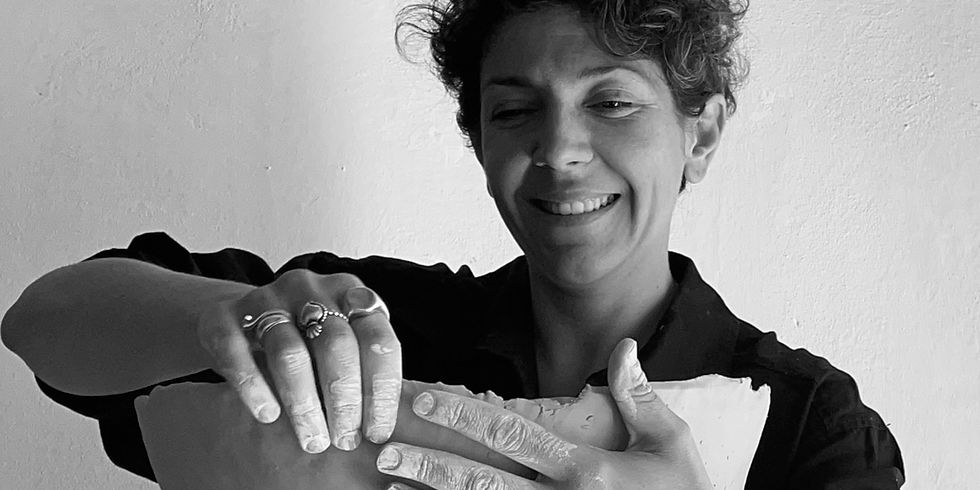
Angelica Tulimiero: Movement, Matter and the Living Language of Clay
Updated: Sep 4
Interview by Valeria Zerbo and Amalia Di Lanno
Photos: courtesy of the artist
There is something in the work of Angelica Tulimiero that resists stillness. Whether through layered textures, undulating surfaces or forms that seem to grow organically, her sculptures evoke a continuous state of transformation. Rather than representing nature, they reveal its underlying rhythms, where movement, geological forces and the internal structures of matter become a language through which to explore emotion and human experience.
Having lived and worked across Europe and Asia, the Italian ceramic artist has developed a practice shaped by encounters with different cultures, ceramic traditions and materials. Yet her research remains deeply rooted in the territory where she grew up. Raised in Campania, where the presence of Mount Vesuvius is a constant reminder of the Earth's perpetual transformation, Tulimiero approaches clay as a living material—one that carries memory, embraces unpredictability and reflects the dynamic processes found in nature.

At the heart of her practice lies an ongoing exploration of materiality. From wood firing to the dialogue between ceramics and textiles, each work emerges through a balance of control and spontaneity, where making becomes a way of investigating movement, memory and transformation. This research contributes to the evolving landscape of contemporary Italian ceramics, explored through the voices of artists featured in our guide to Independent Italian Ceramic Designers & Artists.
Your journey has taken you to live and work in several countries. How have these experiences influenced the evolution of your artistic research?
My nature has always pushed me to move and explore. Everything I encounter and learn becomes woven into my practice. New materials and working methods have certainly expanded my research, but so have colours, customs, ways of living and nature itself. Everything blends into my sensitivity and re-emerges in my work.
Your work conveys a strong sense of movement and an almost organic tension. How has the presence of Mount Vesuvius and the territory where you grew up influenced your imagination?
I believe that, unconsciously, anyone who is born in a seismic and volcanic region grows up with an awareness of instability, movement and constant geological evolution.
I have often reflected on this, and on the fact that, ultimately, everything moves in one way or another. The idea that everything is made up of multiple parts interacting with one another, moving and communicating, has always fascinated me.
Angelica Tulimiero, Mofumofu #5, 2020. Stoneware, glaze and wool. Courtesy of the artist.
Angelica Tulimiero, Mofumofu #5, 2020. Stoneware, glaze and wool
The repetitive textures and structures found in your work are immediately recognisable. Where does this research come from, and what does it allow you to express?
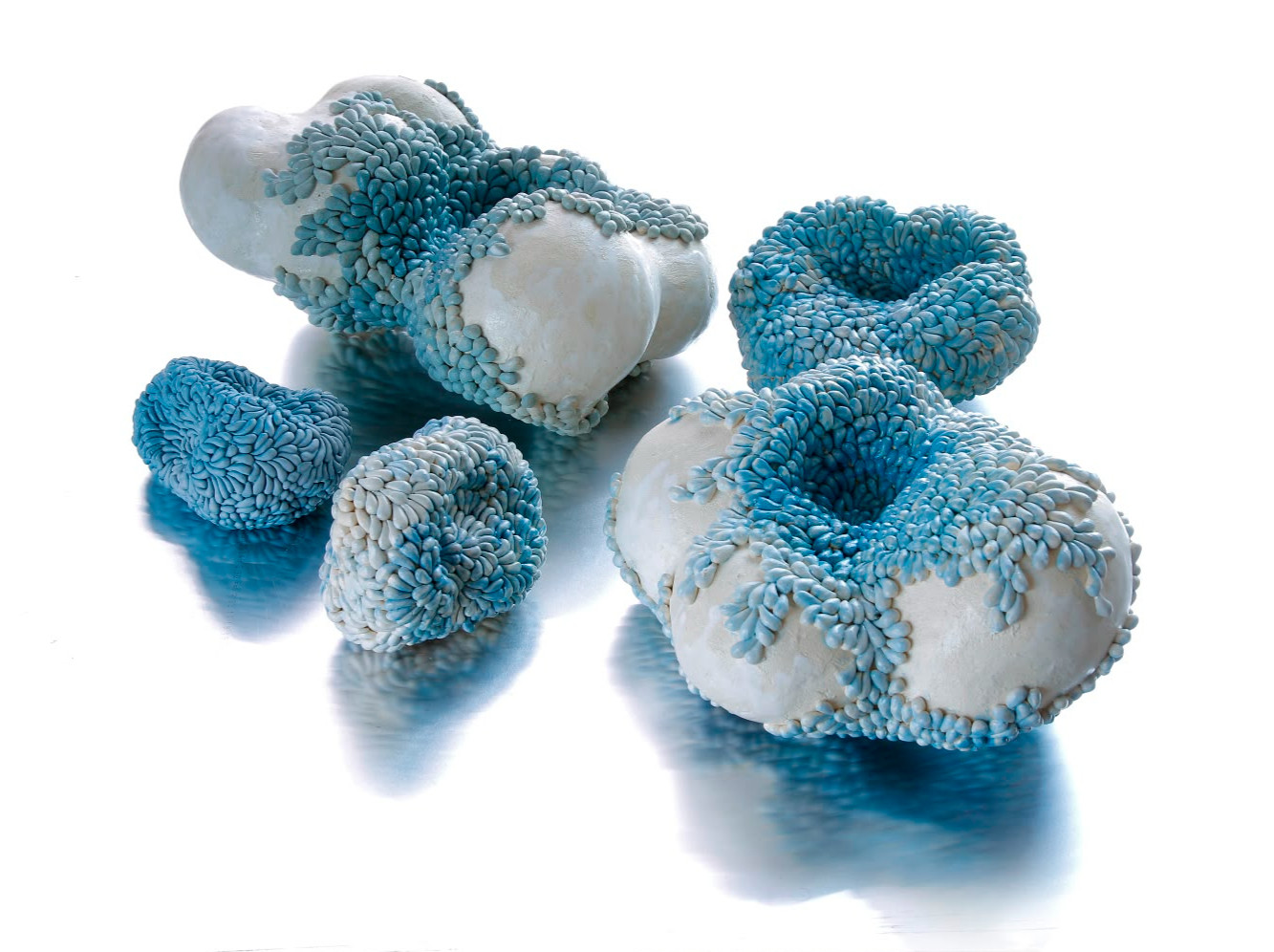
This way of working emerged almost unconsciously, as an intimate and visceral feeling that came from within. It then developed through observing microscopic images and nature in general.
It helps me express movement and reflect on how we are made. It certainly also has a decorative quality, but at times I push it towards obsession, almost to the point of becoming unsettling, like an open wound.
In some of your works, ceramics enter into dialogue with other materials. What interests you about these encounters, and what new expressive possibilities do they offer?
For the TakoTsubo series, I used fabrics that belonged to my mother. I was looking for a way to express the process of grieving when I came across Takotsubo Syndrome, also known as Broken Heart Syndrome.
I created hearts in stoneware and porcelain from which the fabrics from our home emerge. In this work, they represent memory in a tangible way.
In other series, the use of different materials has helped reinforce an idea or a contrast, creating a sense of preciousness or a different emotional response.
The relationship between material and memory also emerges in our conversation with Italian artist Federica Paglia, whose practice similarly explores how materials can preserve presence, emotion and lived experience through contemporary ceramics.
“Everything is made up of multiple parts interacting with one another, moving and communicating.”
Angelica Tulimiero
On the left: Angelica Tulimiero, Incontri, 2025, Stoneware and glaze. On the right: Angelica Tulimiero, Glitch, 2024. Porcelain, stains and glazes
The dialogue between different materials is a recurring theme in contemporary Italian ceramics. A complementary perspective can be found in our interview with Federica Paglia, whose practice explores how ceramics, embroidery, brass, and tin serve as vessels for memory, perception, and lived experience.
Wood firing has played an important role in your practice. What draws you to this process, and what value do you attribute to the role of fire in the final result?
Wood firing has always fascinated me because of its power, unpredictability, physical effort, surprise, and the challenge of controlling such a powerful element.
For some works, the effect of flame and ash melting into glaze gives each piece a uniqueness that is almost impossible to achieve in any other way.
But I have to admit that, for me, the firing process itself is a complete artistic act.
On the left: Angelica Tulimiero, Unease, 2018. Stoneware, stains and glaze. On the right: Angelica Tulimiero, Non-Compliant, 2025. Yixing clay, jade porcelain and glaze.
What kind of relationship do you hope develops between your works and the people who choose them?
I believe that relationship is established naturally; otherwise they would not choose one of my works. Over the years I have realised that my work can be loved, but it can also provoke discomfort. Either way, it always generates strong emotions.
Looking ahead, what directions would you like your research to explore?
During my most recent residency in China, I explored the translucency of porcelain from Dehua and Jingdezhen, and I know I will return to continue developing my Light Sculptures using the celadon glazes of Longquan.
At the same time, I am returning to working on a larger scale while continuing to explore forms in both stoneware and porcelain.
Bio
Born in Avellino in 1976, Angelica Tulimiero is an Italian ceramic artist whose work explores the language of nature through clay. After studying Applied Arts in Ceramics in Italy, she continued her education at Morley College in London, specialising in ceramics, painting, art and design, before working at Stoltzman & Thomas Sculptural Garden Ceramics. She established her own studio in 2005 and has since developed an internationally recognised practice through exhibitions, collaborations and artist residencies across Europe and Asia.
Her work has been recognised with the First Prize at the International Ceramic Competition of L'Alcora (Spain) in 2015 and finalist positions at the Korean International Ceramic Biennale in 2019 and 2021. Most recently, she has undertaken artist residencies at the Taoxichuan Ceramic Art Center in Jingdezhen and the Longquan Wangu Art Centre in China, where she continues her research into porcelain, celadon glazes and large-scale ceramic sculpture.
Explore the Collection
A curated selection of works by Angelica Tulimiero will be developed in dialogue with the research documented in this Journal entry. These works will be presented as part of future Avant Craft curatorial projects.
Explore More
Every article published by Avant Craft Journal contributes to a broader conversation about contemporary craft, ceramics, material and design.