Inhabiting the Threshold. Federica Paglia between Art, Design and Materiality
Updated: 5 days ago
Interview by Amalia Di Lanno and Valeria Zerbo
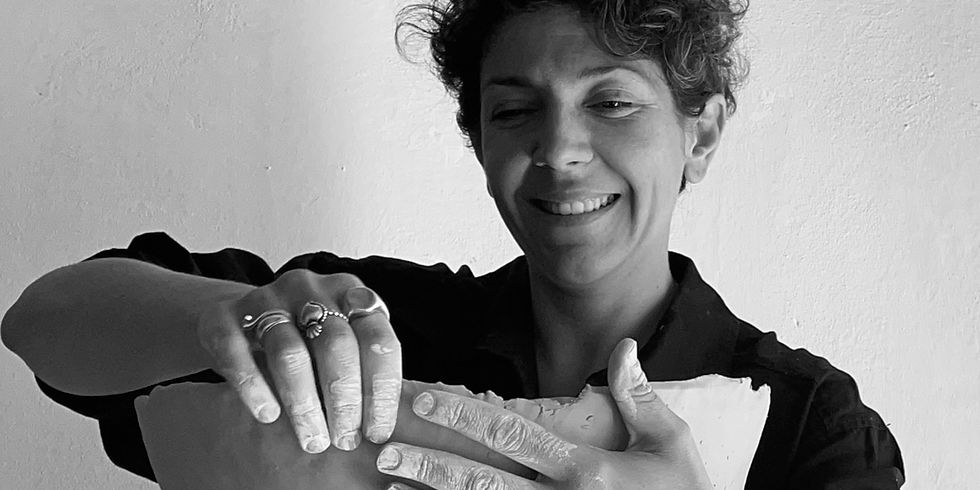
There is something that must be crossed in the work of Federica Paglia: a liminal dimension that quietly permeates her practice, making it both distinctive and deeply compelling. An Italian multidisciplinary artist and designer based between Rome and Milan, Federica Paglia creates handcrafted works that exist at the threshold between contemporary ceramics, art, design and material culture.
With a background in Systemic Design and professional experience spanning design, architecture and fashion, Federica Paglia has developed a practice that approaches the object not simply as a formal or functional outcome, but as a narrative device capable of giving tangible form to memories, perceptions and lived experience.
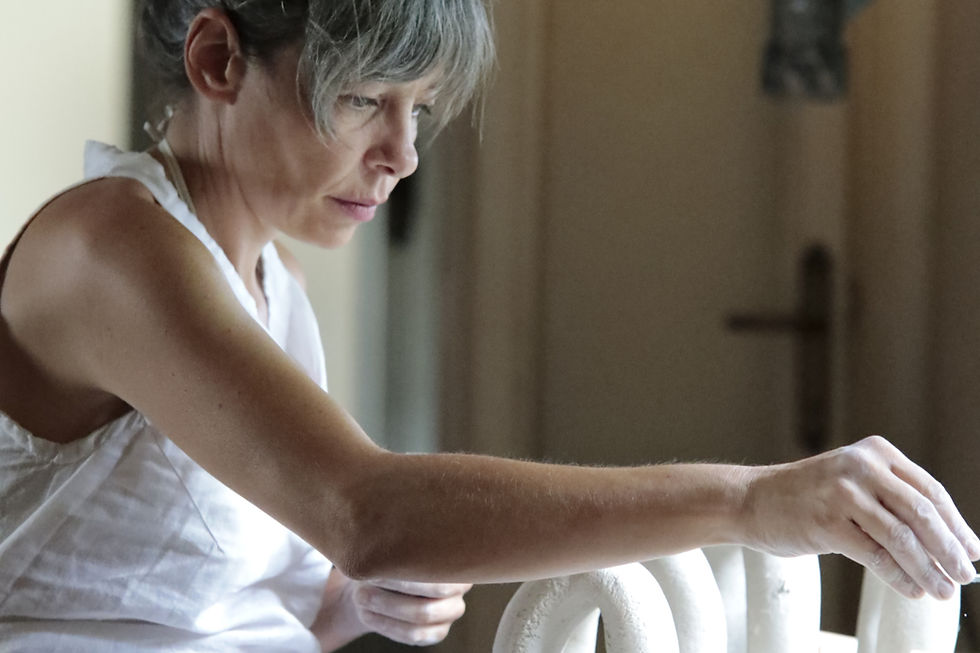
At the heart of her research lies the relationship between gesture and material. For Federica Paglia, craftsmanship becomes a way of translating experience into physical form. Ceramics were her first point of contact with materiality, chosen as a response to the desire to reconnect with the physical act of making after years spent working with digital modelling and rendering.
Around this medium, she has developed an open and experimental approach to materials. Embroidery, glass, brass and, more recently, tin are brought together through stitching, assembly and material juxtaposition, transforming each work into a hybrid object that challenges conventional boundaries. This ongoing dialogue between materials reflects a broader investigation into contemporary material culture and contemporary Italian ceramics.
Many of Federica Paglia's works take the form of vessels—vases, boxes and ritual objects—that preserve memories, evoke unseen presences and suggest meanings extending far beyond their function. It is precisely within this tension between use and contemplation, between utility and poetry, that her practice finds its balance, transforming the threshold between art and design into a fertile space for experimentation, freedom and material expression.
Your background in Systemic Design and your subsequent professional experiences preceded the opening of your independent studio. How has this journey shaped the research and creative practice of Federica Paglia today?
All the experiences that preceded the opening of my studio have been fundamental to the work I do today, starting with my studies in Systemic Design, which nurtured my interest in the ideas and narratives behind each piece's creation.
Subjects such as semiotics, form theory, and metadesign gave me a broader understanding of what it means to design, while also helping me more clearly define what I want to communicate through an object.
My subsequent experiences across design, architecture and fashion further refined this sensitivity towards both design and storytelling. They also made me aware of the importance of communicating one's work through photography, graphic design and the narrative that accompanies every project.
At the top: Gres Nero, ceramic sculpture and detail; at the bottom: Extravases, ceramic vases by Federica Paglia.
In your work, ceramics engage in dialogue with different materials through processes of insertion, stitching and assembly. Where did the desire to introduce these materials into your practice come from, and what does this encounter between different materials allow you to express?
I believe the hybrid nature of my work stems from the fact that I did not begin my career as a ceramic designer. My projects are primarily driven by the desire to transform what I observe and experience in everyday life into tangible matter: the light of a landscape becomes glass-bead embroidery; the geometry of Rome becomes niches and cavities carved into clay; the complexity that surrounds us becomes brass pins guiding threads in ever-changing directions.
Before dedicating myself to this practice, I spent a long time working with 3D modelling and rendering. That experience created a strong desire to reconnect with manual making, which is why I chose ceramics as my first medium for engaging directly with material.
Approaching ceramics as a self-taught practitioner gave me the freedom to experiment with other techniques, such as embroidery, soldering and glass mosaic, without constraints, embracing error and experimentation as an integral part of the creative process.

Flora, ceramic sculpture and details. Courtesy of Federica Paglia.
In your most recent works, you have chosen to work with tin. What drew you to this malleable metal, and what reflections emerge through these new pieces?
I fell in love with tin because of its ability to transform from solid to liquid at around 232°C, a temperature that can be reached with a simple blowtorch.
I began experimenting with the forms it takes when poured in its molten state into cold water, as was done in ancient times and is still practised today in some Nordic countries, where the resulting shapes are interpreted as omens for the year ahead.
The organic, luminous forms immediately reminded me of nature—a hidden, fragmented nature that, when living in the city, we sometimes have to make a conscious effort to see.
In the past, people were surrounded by floral decoration, wallpaper, porcelain and engravings inspired by the natural world: an ornamental language that was authentic and deeply connected to the way people lived. Today, that imagery continues to fascinate us, yet we encounter it far less often.
This is why I decided to reintroduce it onto the surface of an object that recalls the form of a vase but, being closed, functions solely as the container of a message. It is a melancholic sculpture, both for what it evokes and for what it brings back to memory. Yet, despite the coldness of the material and its deformed appearance, it exerts a profound attraction on me.
I began carving the ceramic surface with grooves inspired by the paths climbing plants trace across tree trunks. The subtle undercut created by these incisions allows the tin to naturally adhere to the vertical surface and, through soldering, to receive additional three-dimensional elements, as though they were growing organically from those same branching lines.
Over the years, Federica Paglia has developed a personal language that moves fluidly between ceramics, metal and textile techniques. Her recent works further expand this investigation through new material dialogues and sculptural forms.
Provvisori, ceramic sculptures and details. Courtesy of Federica Paglia.
Your works exist in a space between art, design and material culture. What does it mean for you to work within this in-between territory?
Working within this threshold gives me the freedom to choose my own means of expression. I have always found it difficult to situate my practice within a purely functional context, because that dimension naturally and spontaneously became intertwined with an artistic one.
It was by embracing this inclination that I found my own place as a maker, choosing to create objects suspended between container and content, such as a vase or a box. I believe the piece that best embodies this research is Matcha Green, a ritual object poised between function and poetry.
Many contemporary collectors seek works that establish a lasting relationship with the people who live with them. What kind of dialogue do you hope your works create with those who choose to bring them into their homes?
Knowing that someone shares the same way of looking at the world is important to me. For a moment, it dissolves that sense of solitude which, sooner or later, belongs to all of us.
I imagine the people who choose to live with one of my objects as a quiet, mutual love.
Looking ahead, the research of Federica Paglia continues to evolve through experimentation with new materials and processes.

Looking ahead, what directions do you feel drawn to explore through your work? Are there any materials, processes or themes you would like to investigate further in your future experimentation?
There are countless themes I would like to explore, and each of them requires time. Every project I create needs a long period of reflection before it takes concrete form. It is almost a chance encounter between a lived experience and the right material and form capable of expressing it. Sometimes years pass before those two elements finally come together.
Explore the Collection
A curated selection of works by Federica Paglia will be developed in dialogue with the research documented in this Journal entry. These works will be presented as part of future Avant Craft curatorial projects.
Continue exploring
Every article published in the Avant Craft Journal contributes to a broader conversation about contemporary craft, ceramics, material and design.
Stay Connected
Receive selected Journal stories, artist interviews and visual narratives, together with occasional updates on Avant Craft exhibitions, projects and events.