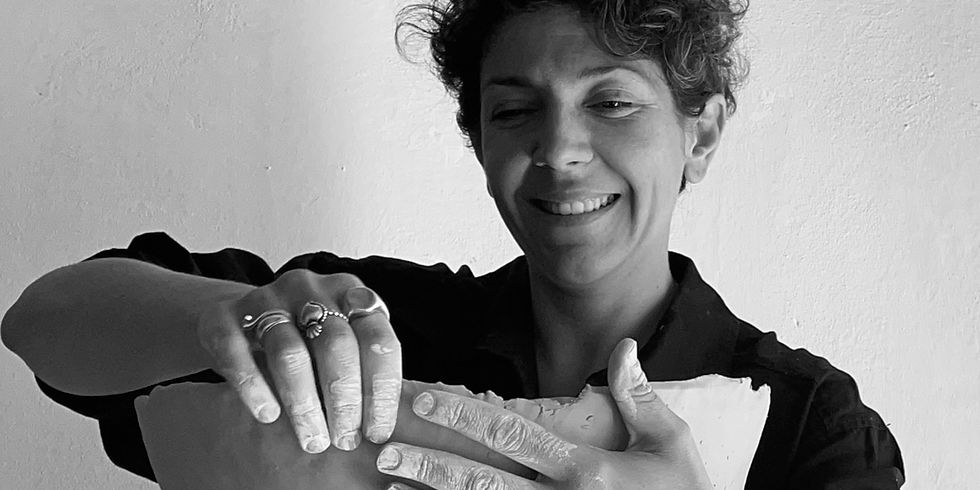
Rossana Rubino. Cartaviva: Fragility, Matter and Transformation
Interview by Valeria Zerbo and Amalia Di Lanno
Photos courtesy of Rossana Rubino / Cartaviva
Working between sculpture, installation and contemporary craft, Italian artist Rossana Rubino explores paper as a material capable of holding gesture, memory and change. Through Carta Viva, her practice brings together paper pulp, textile remnants, fibres and natural materials in works where fragility becomes a generative force.
Rossana Rubino: Paper as a Living Material
Since 2024, paper has become central to her practice. Rather than treating it as a surface on which to work, Rubino breaks it down into fibres, reconstructing it through slow manual processes involving water, natural adhesives, modelling and drying. Textiles, discarded fibres and natural materials can enter the composition, creating objects that sit somewhere between sculpture and installation.
Rossana Rubino’s relationship with materials has been shaped by a background in applied arts and conservation. Both disciplines require an acute awareness of surfaces, traces and time: of what a material has absorbed and what an intervention might leave behind.
The name Cartviva, or living paper, reflects this understanding of the material as something active rather than passive. Paper contracts, bends and responds to pressure and moisture; its behaviour remains partly unpredictable. For Rubino, this uncertainty is not something to eliminate. It becomes part of the work.
Her project Aria, presented during Milan Design Week in 2025, explored the relationship between paper and textile waste, considering discarded material not simply as something to reuse, but as something carrying its own history. More recently, Rubino was selected to present her work in France at the Salon des Beaux Arts at the Orangerie du Sénat.

Your artistic training has moved across different disciplines and materials. How did this journey develop, and what led you to choose paper as the central material of your recent research?
My journey began in applied arts and continued with my training as a laboratory technician specialising in the restoration of works on canvas. Restoration profoundly influenced the way I look at materials: it taught me to pay attention to detail, fragility, layering and time.
To restore something means entering into a relationship with something that already exists, listening to its history and intervening without erasing its traces.
I later attended the three-year Artedo School of Art Therapy, an experience that expanded my relationship with artistic practice and with processes of transformation.
Over the years I experimented with different materials and languages until I felt the need to concentrate on a material capable of directly receiving gesture and time. Since 2024, paper has become the centre of my research.
I am interested in exploring fragility not as weakness, but as a possibility for transformation. Folds, layers and textures make visible the relationship between material, gesture, memory and time.
The name Carta Viva comes from this idea. For me, paper is not simply a support; it is a material capable of reacting, retaining traces and transforming itself through gesture and unpredictability.
At a time increasingly dominated by the immaterial, I feel a need to restore value to physical presence, to the trace of the hand, to imperfection and to the time required to make something. The more images can be artificially generated, the more material and direct experience acquire value.
You presented Aria during Milan Design Week. How did the project develop your research into paper, textile waste and material transformation?
Aria allowed me to bring my research into a context where art, design and contemporary craft can meet.
I worked on the relationship between paper and textile remnants, considering recovered material not simply as an additional element, but as a presence capable of modifying both the form and meaning of the work.
Discarded material carries a history. Transforming it does not mean erasing that history, but allowing it to continue through another form.
In Aria, fragile and residual materials found a new presence within the space, becoming part of a process of transformation that also raises questions around sustainability.
For me, recovering discarded material does not simply mean finding another use for it. It means recognising what it has already been and opening it to another possibility. This principle belongs to my wider research: transforming matter without denying its past, allowing what it carries to continue living through a new form.
Coltivare il Margine, 2025. Pure cellulose paper pulp with flour-based adhesive, white enamel finish
On the left: Rossana Rubino,Seconda Trama, 2026. Pure cellulose paper pulp, flour-based adhesive and textile, finished with white enamel finish. On the right: Rossana Rubino, Coltivare il Margine, 2025. Pure cellulose paper pulp with flour-based adhesive, white enamel finish
From breaking down the paper to creating the pulp and allowing it to dry, every stage of your process seems to have a precise role. Can you take us through the making of a work?
The process is an integral part of my work. Each piece develops through a sequence of precise stages, although the final result is never completely predictable. I am interested in precisely this balance between method and possibility.
I recover and select the paper, then break it down manually until the fibres begin to separate. I combine these fibres with natural-based adhesives and allow the mixture to rest for several days before working with it again.
The modelling stage follows. Here I search for the form without imposing it entirely.
Paper reacts to water, pressure, the quantity of adhesive and the way the fibres have been processed. Drying also affects the final form, creating contractions, tensions and deformations.
I do not consider these variations mistakes. They are part of the process. I observe what happens and allow the response of the material to guide the next stage.
Depending on the project, I introduce fabrics, fibres, textile remnants or natural materials, creating different dialogues between the elements.
There is therefore a precise structure, but within it I leave room for listening. It is through the encounter between what has been planned and what the paper gives back that the work finds its direction.
What do you hope remains with someone after encountering your work?
I would like a sensation to remain, before any precise meaning.
I am not looking for a single interpretation. I am interested in creating a space in which someone looking at the work might recognise something personal: a memory, a fragility, a transformation.
Fragility is central to my work because it belongs both to the human condition and to the nature of things themselves. Nothing is truly stable. Everything changes, transforms and recomposes itself.
Through paper, I try to make this process perceptible. Folds, textures, layers and voids reveal that every form already contains the possibility of changing.
I would therefore like the work to leave a question rather than an answer: the possibility of looking at fragility not as something that needs to be corrected, but as a condition capable of generating new forms.
Nido di carta per pietra errante, 2026. Pure cellulose paper pulp and stone. Rossana Rubino Il Grembo, 2025. Pure cellulose paper pulp with flour-based adhesive, finished with white enamel. Ro
On the left: Rossana Rubino, Nido di carta per pietra errante, 2026. Pure cellulose paper pulp and stone. On the right: Rossana Rubino, Il Grembo, 2025. Pure cellulose paper pulp with flour-based adhesive, finished with white enamel
You were recently selected to present your work in France. What does this opportunity mean to you, and what aspect of your research would you like to share with an international audience?
It represents an important step and an opportunity to engage with a context different from the one in which my research has developed.
I believe material can create an immediate dialogue beyond linguistic boundaries. Paper, gesture, transformation and the relationship between fragility and resistance are physically perceptible elements that remain open to different interpretations.
Above all, I would like to share the idea of fragility as a generative force: the possibility that an apparently poor and vulnerable material can acquire a sculptural presence through a slow, manual process.
At the same time, an international context gives me the opportunity to continue testing my research. Every new environment can change the way we look at things and open new directions.
Looking ahead, which directions would you like to explore?
I would like to continue exploring the possibilities of paper without fixing it within a single technique or form.
I am interested in developing the relationship between paper, fibres, textiles and natural materials further, as well as expanding the installation dimension of my work and creating pieces capable of entering into a relationship with space.
I do not want to arrive at a definitive form, but rather to make the process of becoming perceptible. For me, every work represents a temporary moment within a wider process.
The future of my research therefore remains open to possibility, unpredictability and transformation. It is precisely this openness that I would like to preserve in my work.
Bio
Rossana Rubino is an Italian artist whose practice moves between sculpture, installation and contemporary craft. Trained in applied arts and restoration, she has developed a close sensitivity to material, gesture and the passage of time. Since 2024, her research has centred on paper, which she transforms through slow, manual processes and combines with textiles, fibres, discarded materials and natural elements. Her work explores fragility, memory and transformation, allowing the unpredictable behaviour of the material to become part of the final form. In 2025, she presented Aria during Milan Design Week and was selected to show her work in France at the Salon des Beaux Arts at the Orangerie du Sénat.
Explore More
Continue discovering the ideas, materials and processes shaping contemporary craft through our conversations with artists and makers.
Discover the Artists & Designers
Meet the independent artists and designers selected by Avant Craft, and discover the practices, materials and stories behind their work.
Explore the Collection
Discover a curated selection of contemporary Italian art, craft and collectible design by independent makers.
Explore the Collection