

Kate Malone. Optimism in Clay: Nature, Growth and Transformation
Updated: 4 days ago
Interview by Valeria Zerbo and Amalia Di Lanno
Images: courtesy of Adrian Sassoon, London
There is something that must be relinquished in the work of Kate Malone: the possibility of complete control. Clay responds to the hand, glaze begins to move, crystals grow through heat, and the kiln introduces forces that can be guided but never entirely anticipated. For Malone, this uncertainty is not something to overcome, but an essential part of making.
A British ceramic artist working between Kent and London, Malone has spent four decades developing a distinctive language shaped by an intense observation of nature and an equally rigorous investigation into glaze. Kate Malone ceramics are recognised for their sculptural forms, vivid colour and complex crystalline surfaces. Represented by Adrian Sassoon, her principal dealer, her work moves from the abundant forms of her Pumpkins, and Artichokes to the geological language of the Magma series.

Nature, however, enters Malone’s practice as more than a visual source. Seeds, fruit, geological formations, gravity and growth become ways of understanding transformation itself. A peach stone kept for twenty years can become the starting point for a new sculpture; the seed inside an apple becomes evidence of the extraordinary potential contained within the natural world.
Optimism is closely connected to this understanding of growth. It is not simply expressed through colour or exuberant form, but through Malone’s belief in process: the possibility that an idea can develop without its final outcome being known in advance. Technical knowledge provides the foundations, but it does not eliminate uncertainty. This balance between accumulated knowledge and unpredictability is central to Kate Malone ceramics, where form, surface, gravity and fire remain closely connected. Malone’s extensive glaze archive contains thousands of recipes, yet fire, gravity and material continue to participate in determining the finished work.
This dialogue between knowledge, material and unpredictability is also central to the broader language of contemporary ceramics explored in Avant Craft’s Italian Handmade Ceramics Guide and our archive of Independent Italian Ceramic Designers & Artists.
For Malone, connection extends beyond the relationship between artist and material. She speaks of friendships that have developed with those who live with her work and of her commitment to introducing younger generations to clay through FiredUp4. Making becomes a way of connecting across different scales and different moments in time: between hand and matter, artist and collector, and contemporary makers and those who shaped clay thousands of years before them.
In our conversation with Kate Malone, we discuss nature and control, the transformation of clay through fire, the relationship between form and glaze, the evolution of the Pumpkin, and why clay can still offer what she describes as a tangible form of magic.
“Sometimes you don’t know how something is going to happen, but you have to have faith that it will grow. There is optimism in that.” — Kate Malone
On the left: Kate Malone studying and drawing an artichoke, reflecting the close observation of natural forms at the heart of her practice. Ph. by Alun Callender. On the right: Seeds, shells, found objects and natural forms gathered by Kate Malone as sources of observation and inspiration. Ph. by Alun Callender.
Your work often balances intention with unpredictability. How much do you seek control, and how much do you leave to the material and the firing process?
I believe you have a spark of an idea. Often, I don’t actually have a final image in my mind, so I start making and hope that somehow it will emerge. It isn’t only about letting the firing process take over; it is about having faith in the process of making.
At the moment, for example, I’m working from a peach stone. I collect seeds, and I have a peach stone here that I’ve kept for about twenty years, simply because I ate a peach one day and thought the stone was beautiful. Now I’ve enlarged it and I’m making this strange pot from it. When you look closely at a peach stone, you can almost imagine a landscape of hills and valleys.
I begin with this vague cloud of an image and then meet the idea through making.
Of course, if I’m making something like a Pumpkin, the form is clearer. Then I can allow the glazes to have their moment. The combinations of glazes bring excitement, freedom and a lack of control.
My favourite moment is when I walk into the studio and think, I don’t know what I’m doing. It’s almost like an artist’s holiday. I make something, wrap it up, come back the following day and see it again.
Being out of control can be the best thing.
How does your relationship with the material change before and after firing?
For me, there is something extraordinary about the transformation from clay into ceramic because it is irreversible.
When we make with clay and fire it, we become connected to the elements. Then glaze introduces another relationship. It moves with gravity — everything naturally wants to move down the surface of the pot.
With crystalline glazes, you are deliberately encouraging that movement. You are pushing the glaze and allowing it to move and change. Some people working with crystalline glazes are primarily interested in the crystals themselves, which is wonderful, but for me the movement is just as important.
Experience gives you knowledge. Through repetition, you begin to understand where things are likely to move and what the materials might do. But you never know completely.
I find that relationship with the elements very beautiful.
On the left: Kate Malone, Monumental Magma Gourd, 2022. Crystalline-glazed stoneware. Ph. by Sylvain Deleu. On the right: Kate Malone, Pale Green Crystal Pumpkin, 2026. Crystalline-glazed stoneware. Ph. by Sylvain Deleu
Nature has always been central to your work. Has it become more than a source of inspiration — perhaps a philosophy for how you create?
Nature, in its abstract sense, is the essence of my inspiration.
I used to be quite concerned about being botanically specific. Then I realised that every single leaf is different. There aren’t two apple trees that are exactly the same. Whatever leaf I make could exist somewhere.
The more you look at nature, the more extraordinary it becomes. You eat an apple and there is a seed in your mouth, and that seed can become another tree. It is just a miracle.
The Pumpkin came through that kind of process too. I didn’t deliberately decide to create a Pumpkin. Looking back, I can recognise different things that had touched me: the fullness of forms I had encountered in art, and a wooden pumpkin that I bought while travelling in India. I didn’t have much money at the time, but there was something about it that touched my heart.
In the studio, I began coiling these very full, plump forms. At first, the Pumpkin remained a jug or a vase. I couldn’t quite break away from the usefulness of the vessel. It took many Pumpkins before I eventually closed the form completely and added the stem. Then it became sculptural.
It evolved through having faith in the process.
I suppose that becomes a philosophy for life as well. Sometimes you don’t know how something is going to happen, but you have to have faith that it will grow.
There is optimism in that.
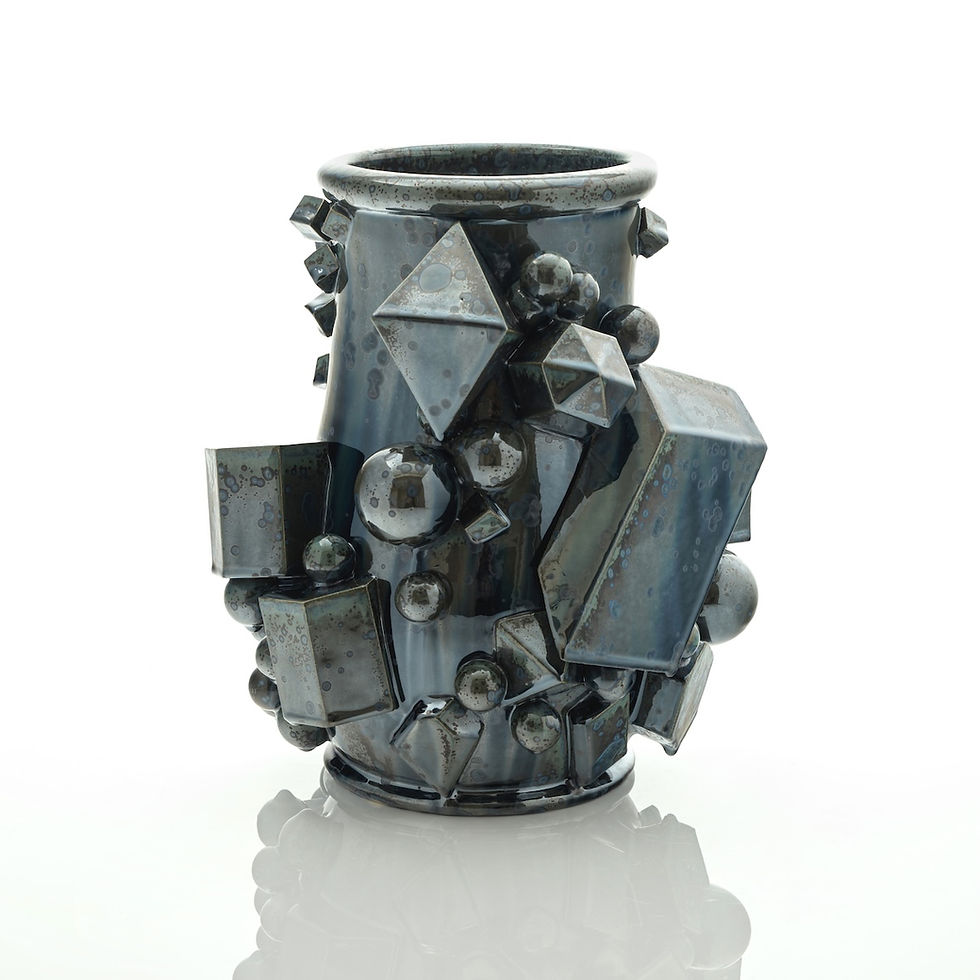
Top left: Kate Malone, Monumental Magma Gourd, 2022. Crystalline-glazed stoneware. Ph. by Sylvain Deleu. Top right: Detail of Kate Malone, Monumental Magma Gourd, 2022. Crystalline-glazed stoneware. Ph. by Sylvain Deleu. Bottom: Kate Malone, Black Magma Vase, 2024. Crystalline-glazed stoneware. Ph. by Sylvain Deleu.
Your sculptures are defined as much by their form as by their extraordinary glazes. How do form and surface develop together?
I feel very strongly that surface should relate to form.
As a child, I remember my mother wearing fishnet tights. I would sit on the floor and look at the pattern across her legs. The diamonds became larger across one part of the body and smaller around the knee or ankle. I was fascinated by that relationship between pattern and volume.
It is similar with ceramics.
First there is the making of the form, where I have a certain degree of control. Then I decorate the surface, hoping that the decoration responds to that form. Finally, the glaze moves across the object and describes the surface again.
I mainly work with two types of crystalline glaze: opaque and transparent. With fine detail, I can use a transparent glaze so that the form remains visible. On other areas, I can use opaque glazes, where the crystals become much more spectacular.In the studio we have what we call the Glaze Bible, with around three thousand recipes. I’m very generous with the recipes because other people have been generous with me in the past.
But even with all that knowledge, you never have complete control. Raw materials change. Cobalt bought today might behave slightly differently from cobalt bought previously.
A Pumpkin might have five or six opaque glazes layered with transparent ones. I know something about what they are going to do, but I can never know exactly how they will respond to one another.
The form itself dictates the movement. The Pumpkin is a wonderful shape because it has humps, recesses and descents.
There is knowledge, but there is always space for something else to happen.
Once a piece leaves your studio, what kind of relationship do you hope its owner develops with it over time?
I’ve developed friendships through people buying my work.
Someone loves a piece and already there is a communication between us. Over the years, I’ve become very close friends with some people who have collected a lot of my work.
In a way, they already know me because I communicate through the work.
Of course, selling the work is important. I need to make a living and support the studio, my assistants, my family and the wider team. But as the decades pass, you begin to realise that there is something bigger than that.
The work builds relationships.
Even if somebody has only one piece, they already slightly know me because they’ve got me in their house. Then it becomes a pleasure for me to get to know them too.
Through FiredUp4, you have introduced many young people to ceramics. What do you hope they discover through working with clay that they cannot learn elsewhere?
When I was twelve or thirteen, I was incredibly fortunate. At school I had pottery, woodwork, metalwork, sewing, printing and art. It was a state school, and I simply took that education for granted.
I had access to clay early enough to develop what I think of as a hand-to-brain awareness — a “haptic” understanding. I had a head start because I already knew that relationship between the hand and the mind before applying to art college.
Over time, craft was gradually pushed out of many schools, and I felt that I couldn’t simply sit down and do nothing about it.
Through FiredUp4, pottery is now available to as many as 3,000 young people a week in the centres we work with. Many are in areas where their families would never otherwise be able to take them to a pottery class.
The first thing I hope they discover is that connection between hand and mind, because it can be incredibly liberating.
Then there is the empowerment that comes from seeing clay become ceramic. You feel that you have created this thing, although of course the elements and the kiln have played their part.
The young people tell us that making makes them feel calmer, gives them a sense of achievement and increases their self-respect. It can also unlock emotions. Sometimes children begin opening up while working with clay, which means that difficulties elsewhere in their lives can be recognised.
I’ve experienced something similar myself. Through difficult moments, clay has always been there.
Clay is inert — related to stone, sand, rock and glass — but it feels extraordinarily alive. It has been generous to human beings for thousands of years.
And there is another connection. You can squeeze a soft piece of clay in your hand today and then look at a ceramic object made thousands of years ago and know that somebody once experienced that same sensation. Sometimes you can see their fingerprints and imagine the hand that made it.
"Working with clay connects you across time with other makers." — Kate Malone
As children, we are told that magic doesn’t really exist. We have fairy tales and wishes, but they are intangible.
Clay offers a kind of magic that is tangible.
The more time I spend with clay, the more I appreciate it. It isn’t simply a material. Sometimes, particularly when the world feels difficult, I wonder whether making these things is frivolous. But it isn’t.
Art and making are part of the essence of being human.
On the left: Kate Malone, A Large Striped Atomic Vase, 2024. Crystalline-glazed stoneware. Ph. by Sylvain Deleu. On the right: Detail of Kate Malone, A Large Striped Atomic Vase, 2024, showing the interaction of colour, crystalline glaze and applied spherical forms. Ph. by Sylvain Deleu.
Biography
Kate Malone MBE is a British ceramic artist working between Kent and London. She studied ceramics at Bristol Polytechnic before completing an MA in Ceramics at the Royal College of Art in London in 1986.
Over four decades, Malone has developed an internationally recognised practice distinguished by sculptural form, vivid colour and extensive research into crystalline glazes. Nature remains central to her work, from the growth, ripeness and abundance of botanical forms to the geological forces explored through works such as the Magma series.
Alongside her individual sculptural works, Malone has undertaken major architectural and public commissions, including the crystalline-glazed façade of 24 Savile Row in London. Her work is held in numerous public collections internationally, including the Victoria and Albert Museum, the Ashmolean Museum, Sèvres – Cité de la céramique, the Los Angeles County Museum of Art and the Museum of Fine Arts, Houston.
Malone was awarded an MBE for services to ceramic art in 2019 and was a finalist for the LOEWE Foundation Craft Prize in 2022. She is Co-Founder and Ambassador of FiredUp4, supporting greater access to ceramics for young people. In 2027, the Wadsworth Atheneum Museum of Art in Connecticut will present MATRIX 200: Kate Malone.
Continue exploring
Every article published in the Avant Craft Journal contributes to a broader conversation about contemporary craft, ceramics, material and design.


Stay Connected
Receive selected Journal stories, artist interviews and visual narratives, together with occasional updates on Avant Craft exhibitions, projects and events.


