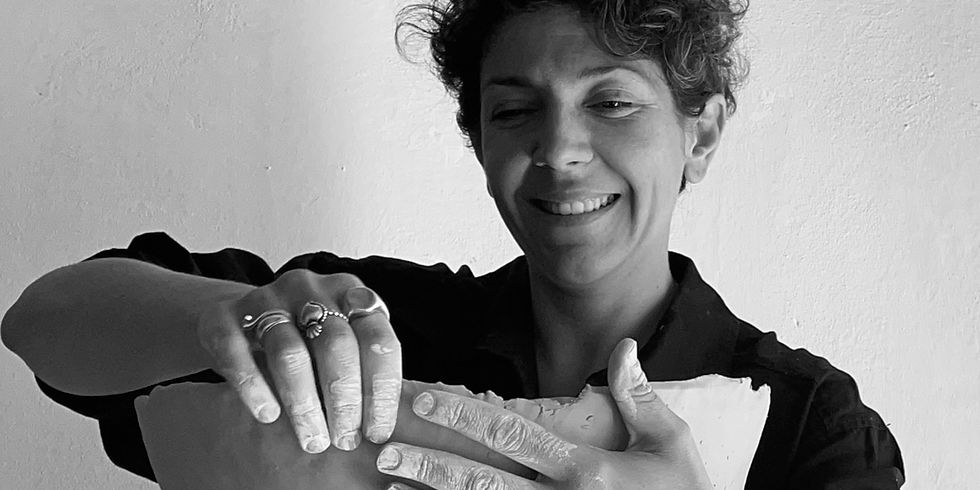
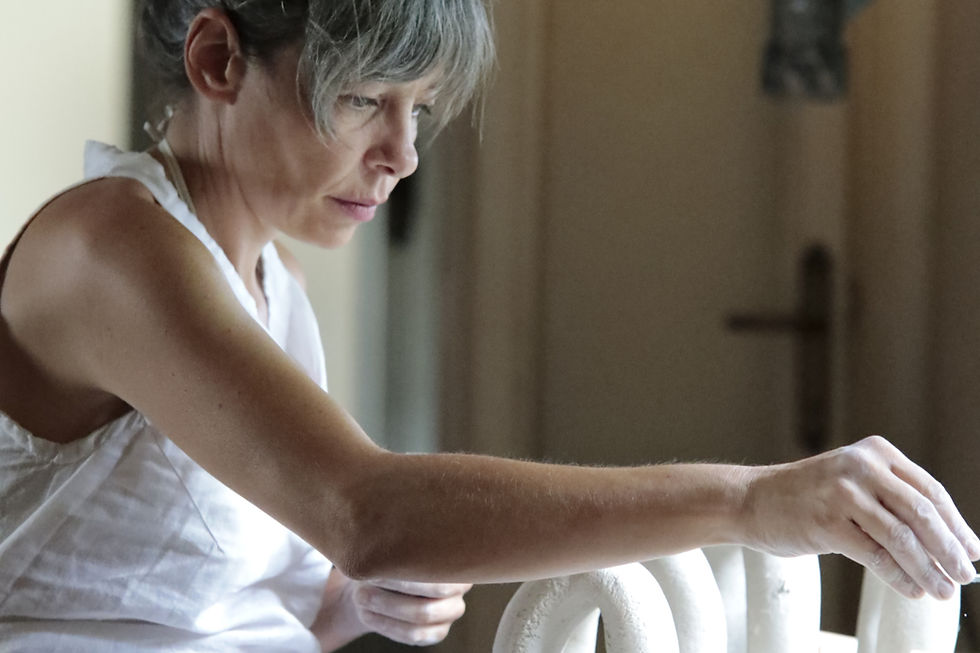
Paola Paronetto and the Language of Paper Clay
Updated: 4 days ago
Interview by Amalia Di Lanno and Valeria Zerbo
Over the last three decades, Paola Paronetto has developed one of the most distinctive voices in Italian contemporary ceramics. At the heart of her practice lies paper clay, a material she transformed from a technical experiment into a personal language capable of expressing lightness, emotion and individuality.
Yet for Paola, the life of a work truly begins when it leaves the atelier. Once placed within a home and woven into everyday rituals, each piece gradually acquires a new meaning. What begins as an expression of her vision becomes part of someone else's emotional landscape.
This relationship between handmade ceramics and lived experience is central to her work. As she explains:
"The work should not simply impose its own beauty; it should learn to listen to the life of the person who welcomes it."— Paola Paronetto
In this conversation, Paola reflects on the masters who shaped her path, the discovery of paper clay, and the evolution of her practice from functional ceramics to forms that carry memories, emotions and stories.

From your first lessons with Nello Minelli to the years spent alongside Giuseppe Temperoni, your education was deeply connected to the figure of master ceramicists. How important were these encounters in shaping your language, and what legacy do you still carry with you today?
My first teachers and my earliest experiences with ceramics were essential in starting a journey of knowledge that naturally evolved over the years. They marked the beginning of a profound discovery of all the expressive possibilities of this material. I made them my own and transformed them into stages of a journey towards myself — one that I imagine will never truly end.
Throughout your training, you explored many techniques and materials, from wheel throwing to raku, terra sigillata and lustres. How important was it to move through different languages before finding your own voice?
Experimentation was a necessary and almost inevitable step. Without that journey through such different techniques, I would never have acquired the tools needed to shape my own voice. It became the starting point for establishing a dialogue with the material and interpreting it through my personal harmony of forms and colours.
Paper Clay Collection, Bottles and Vase Fide, 2019. Ph. Courtesy of Paola Paronetto
Over time, your work gradually moved away from functionality and towards a more poetic and sculptural dimension. How did your way of conceiving the object change?
Once I felt capable of mastering clay through all the traditional techniques, I felt the need to move beyond established rules and create something truly unique. I wanted to make something that no longer looked like ceramics, something that would provoke curiosity and questions. Something light, dynamic and singular — and that is how my Cartocci were born.
Over the years, I stopped asking myself what a piece was for and started asking what it communicates. If at first the challenge was to master the material and its function, today the challenge is to challenge the material itself — to remove its weight and make it airy and vibrant. The object is no longer a container for things, but a container for emotions and stories.
The discovery of paper clay marked a turning point in your career. Do you remember the moment you realised that this material would transform your work?
There is a precise moment linked to my encounter with Giovanni Cimatti, to his magnetic personality and the sparks in his eyes while he worked. He was the one who triggered something within me and made me understand that paper clay would become the perfect material to finally give shape and life to forms that until then I could only imagine.

Paper clay eventually became much more than a technique; it became a language. How did this research develop, and how long did it take to arrive at your own formula?
Achieving what I had in mind required time, patience and countless tests, including revealing mistakes. It is a process of profound connection with the material, based on calibration and layering, and it took years of work.
Today, I can say that this entire process and its results have become my signature — the language through which I express my vision. But research never stops. Materials change, intuitions evolve, and each new piece brings with it a new challenge to explore.
With collections such as Cartocci, individual objects seem to give way to compositions and families of forms in dialogue with one another. When did this approach emerge?
In truth, I felt this connection from the very beginning. I immediately recognised them as part of myself, perfectly aligned with my spirit, almost as if they were multitudes born from my inner world. For me, it has never been a purely design decision, but rather the necessity to give space to a chorus of forms that seek and complete one another.
Today your work moves between contemporary art and collectible design, finding a place in galleries, museums and international events. How do you experience this dialogue between craft, art and design?
I love it. I find the interaction between these worlds one of the most stimulating aspects of my work. I have never liked rigid boundaries. For me, craft is the wisdom of the hands, design is the thought behind form, and art is the freedom of expression.
Seeing my works move naturally between an art gallery and a design space confirms that when a material is sincere, it can speak different languages without losing its identity.
Paper Clay Collection, Water Lilies and Composition, 2025. Ph. Courtesy of Paola Paronetto
Your atelier has grown into a structured reality recognised internationally. How do you preserve the uniqueness and handmade quality of each piece?
The secret lies in the team I have built over time and in the way we work. Despite our growth, everything remains entirely handmade, from the preparation of the clay body to the application of colour. I work alongside my assistants every day and we share the challenges posed by natural materials.
Humidity, climate and even the behaviour of the kiln influence the final result. This sensitivity to the material prevents standardisation and guarantees the uniqueness of every piece.
You have often said that you wish your objects to bring joy and inspiration. What kind of relationship do you hope develops between your works and the people who choose them?
I imagine entrusting my works as if they were children entering a different world, where they will encounter new environments, lights, scents and atmospheres.
Over time, I like to think that the object gradually loses its sense of novelty and becomes filled with memories, stories and everyday gazes. The real magic happens when people stop seeing the piece as my creation and begin to feel it as part of their own identity and emotional landscape. That is when the object finds its true home and its true voice.
Continue exploring
Every article published in the Avant Craft Journal contributes to a broader conversation about contemporary craft, ceramics, material and design.
Stay Connected
Receive selected Journal stories, artist interviews and visual narratives, together with occasional updates on Avant Craft exhibitions, projects and events.